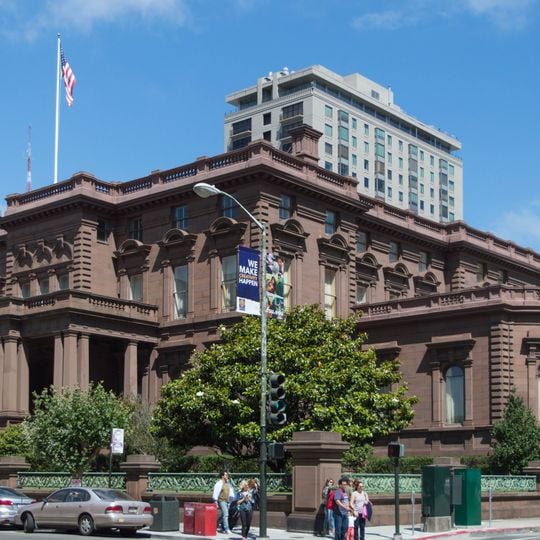
James Flood Mansion, Brownstone mansion in Nob Hill, San Francisco, US.
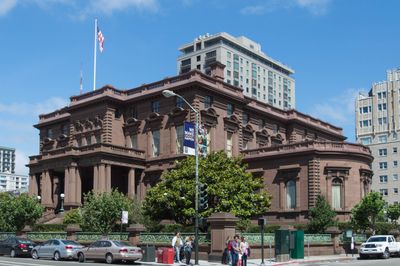
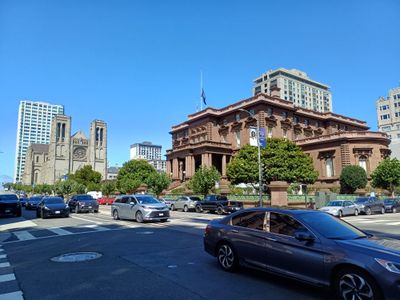
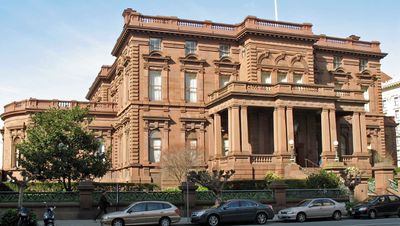
The James C. Flood Mansion is a three-story brownstone at 1000 California Street, occupying a full block on Nob Hill. Its Classical Revival facade has corner quoining, a balustraded roofline, and windows framed by pilasters and pediments. A broad three-bay portico with clustered square columns shelters the California Street entrance. The Pacific-Union Club occupies the building.
James C. Flood, who made his fortune in Nevada's silver mines, commissioned architect Augustus Laver to build this townhouse, completed in 1888. It was gutted in the 1906 earthquake and fire, and Flood's daughter sold the shell to the Pacific-Union Club, which hired Willis Polk to add a third floor and a new interior using brownstone from the original quarries. It was the only Nob Hill mansion to survive structurally, the others being wood finished to look like stone.
The Pacific-Union Club bought the gutted shell from Flood's daughter and first considered demolishing it, then hired Willis Polk to add a third floor and a new interior, using brownstone from the same Portland, Connecticut quarries. The club, a private gentlemen's organization, still occupies the mansion at 1000 California Street.
The building stands at an easily accessible corner in the Nob Hill neighborhood and can be viewed from the outside, though visitors cannot enter the interior. The best time to view and photograph it is during daylight hours when the facade is well-lit and the architectural details are clearly visible.
This building was the first brownstone structure built west of the Mississippi River, using materials sourced from eastern quarries. The choice to import these building stones all the way to the West Coast reflects the importance placed on this residence and the city's early trade connections.
The community of curious travelers
AroundUs brings together thousands of curated places, local tips, and hidden gems, enriched daily by 92,795 contributors worldwide.