Bull Run Lake, lake in United States of America
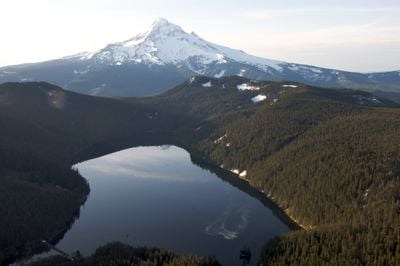
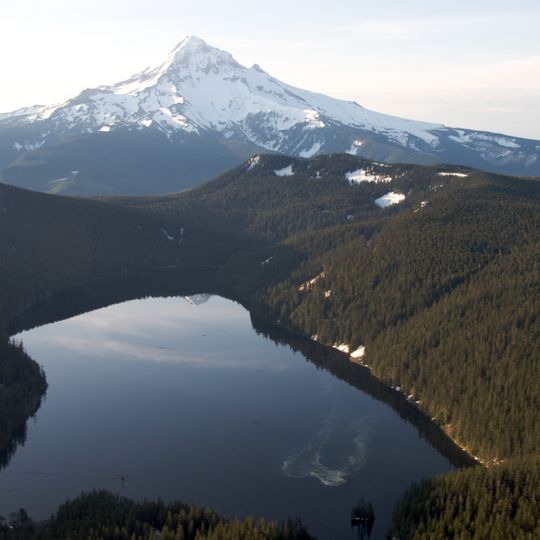
Bull Run Lake is a 1.89 km² reservoir on the Bull Run River in Mount Hood National Forest, about 14 km northwest of Mount Hood on the Clackamas–Multnomah county line. Its shoreline runs 6.8 km, and its level is held between 664 and 667.4 m above sea level by an outlet dam with gates at 959 and 963 m.
The lake was protected in 1892 by President Benjamin Harrison to keep the water source safe from development and grazing, marking one of the earliest efforts to shield a drinking water supply. By 1895, water began flowing through pipes to Portland, giving the city a reliable water system.
The lake lies on the Clackamas–Multnomah county line in Mount Hood National Forest, and its name comes from the Bull Run River it feeds. Since the late 19th century its water has been the main drinking source for Portland, so entry is closed to the public to prevent contamination. Geographer Lewis A. McArthur in 1925 ranked it with Crater Lake as one of Oregon's two most important lakes, supplying water to a third of the state's population.
Public entry has been restricted since 1892, when the Bull Run Reserve was created, and Theodore Roosevelt limited access to government agents and water company employees in 1904; the lake lies on the Clackamas–Multnomah county line in Mount Hood National Forest, about 14 km northwest of Mount Hood. The basin receives over 110 inches (2,800 mm) of rain a year, so expect wet, fast-changing conditions.
In 1925 geographer Lewis A. McArthur named Bull Run Lake one of Oregon's two most important lakes, alongside Crater Lake, because it supplied drinking water to a third of the state's population. The basin above it receives more than 110 inches (2,800 mm) of rain a year.
The community of curious travelers
AroundUs brings together thousands of curated places, local tips, and hidden gems, enriched daily by 93,771 contributors worldwide.