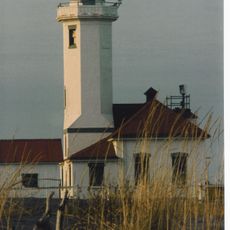
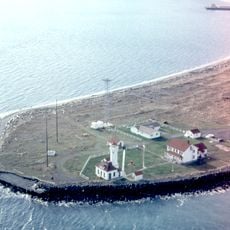
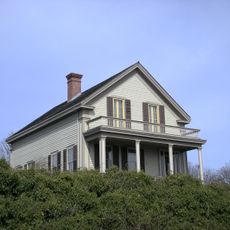
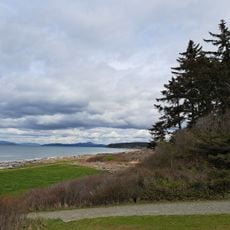
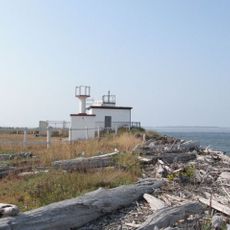
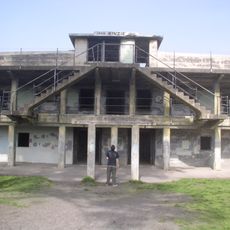
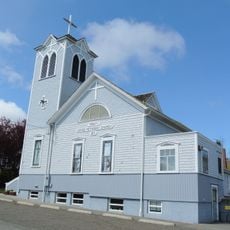
Admiralty Head Light, Deactivated lighthouse in Fort Casey State Park, Whidbey Island, US.
Admiralty Head Light is a 30-foot brick and stucco tower attached to the corner of a two-story keeper's house, built in 1903 to a design by Carl Leick with thick walls meant to withstand earthquakes and the concussion of Fort Casey's guns. It stands on the grounds of Fort Casey State Park on Whidbey Island, overlooking Admiralty Inlet, and is now a museum visited with volunteers of the Keepers of Admiralty Head Lighthouse.
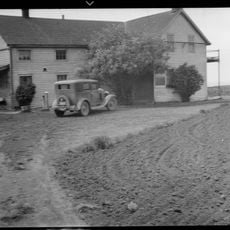
The first lighthouse on Admiralty Head, a wooden two-story house with a gable tower, was completed in 1861 after the U.S. bought 10 acres for $400 in 1858. Construction of Fort Casey forced its relocation in 1890, and it was demolished in 1928. The present 30-foot brick and stucco tower, designed by Carl Leick, was built in 1903 and deactivated in 1922; its lantern went to New Dungeness in 1927.
The lighthouse is now a museum run with volunteers from the Keepers of Admiralty Head Lighthouse, who show visitors the tower and its rooms. Its name comes from Admiralty Inlet, the east entrance point of which is Admiralty Head, the southeast end of the bluffs running north along Whidbey Island's western shore.
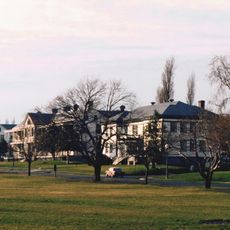
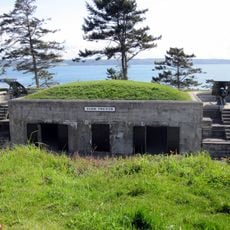
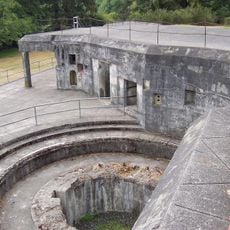
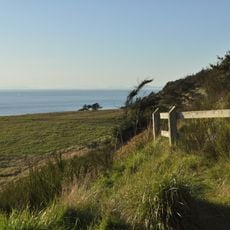
The lighthouse stands on the grounds of Fort Casey State Park near Coupeville, on Whidbey Island. It is open to visitors as a museum run with volunteers from the Keepers of Admiralty Head Lighthouse, and a spiral staircase leads up to the lantern. The surrounding park has gun emplacements and trails along the bluffs above Admiralty Inlet.
The brick walls were specifically engineered to withstand both earthquakes and artillery fire from the adjacent military fortifications. This dual-purpose construction reveals how the structure was adapted to handle the site's two unique environmental and military challenges.
The community of curious travelers
AroundUs brings together thousands of curated places, local tips, and hidden gems, enriched daily by 93,775 contributors worldwide.