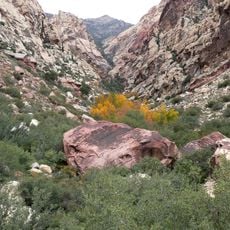
Aztec Sandstone, Sandstone formation in Great Basin Province, Nevada
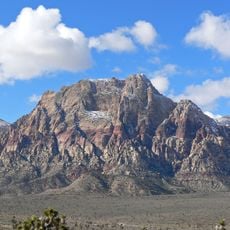
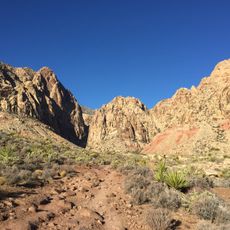
Aztec Sandstone is an Early Jurassic formation of wind-blown sand exposed in the Mojave Desert of Arizona, California and Nevada. It has two units: a lower, resistant tan to off-white sandstone about 100 metres thick with cross-bedded lenses and silica-cemented frosted quartz grains, and an upper, less resistant 200-metre unit of alternating white quartz arenites and red to brown silty sands.
The Aztec Sandstone is an Early Jurassic formation of wind-blown sand, named after the Aztec Tank, a lake in Nevada's Spring Mountain region. Its lower unit, about 100 metres thick, holds cross-bedded lenses and quartz grains cemented by silica, described by Evans in 1958 and 1971. The upper unit, roughly 200 metres thick, alternates white quartz arenites with red to brown silty sands. Fossil pterosaur tracks have been recovered from the formation.
The formation serves as a research site for geologists and paleontologists studying the geological records of the Mesozoic era in North America.
The formation crops out in the Mojave Desert of Arizona, California and Nevada, with the type area around the Aztec Tank in the Spring Mountain region of Nevada. The lower unit forms resistant ledges and the upper unit softer slopes, so expect uneven ground. Summer heat is severe; carry water and sun protection.
Natural depressions in the sandstone collect water to form tanks such as Aztec Tank, creating vital water sources in this dry landscape. These pools supported wildlife and travelers moving through the desert region.
The community of curious travelers
AroundUs brings together thousands of curated places, local tips, and hidden gems, enriched daily by 93,370 contributors worldwide.