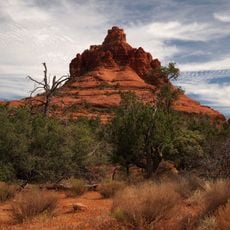
V-Bar-V Heritage Site, Petroglyph site in Verde Valley, Arizona, United States.
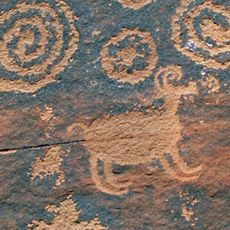
The Crane Petroglyph Heritage Site, long known as V-Bar-V, holds 1,032 petroglyphs in 13 panels, the largest petroglyph site recorded in the Verde Valley. The carvings sit on rock faces reached by an easy half-mile walk from the parking lot. Nearly all belong to the Beaver Creek style, and almost none overlap or carry later designs.
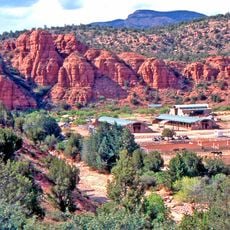
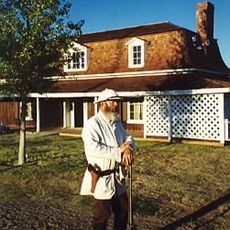
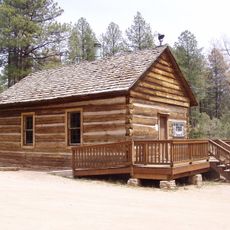
Southern Sinagua residents carved the petroglyphs between about 1150 and 1400 AD. Early American settlers knew the site, and around the turn of the 20th century it became part of a cattle ranch whose buildings still stand near the visitor center. The US Forest Service acquired it in 1994 as the V Bar V Heritage Site, renamed Crane Petroglyph Heritage Site on March 16, 2024.
The petroglyphs define the Beaver Creek rock art style, diagnostic of the Southern Sinagua culture between about 1150 and 1400 AD. About 20% are zoomorphs such as snakes, turtles, coyotes, deer and antelope; anthropomorphs and geometric figures like spirals and grids follow. At Crane Petroglyph all 1,032 images belong to this single style, almost all well spaced with no overlap or newer designs over older ones.
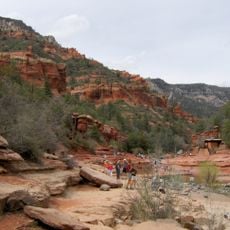
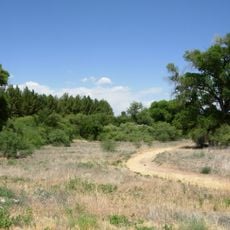
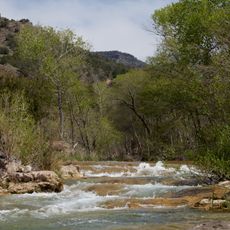
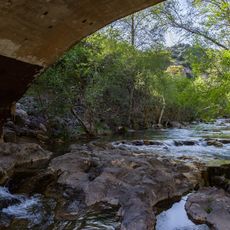
A maintained trail leads from the parking area to the petroglyphs and is easy to walk, with enough time to explore each panel section at a relaxed pace. The site is surrounded by trees that provide shade during hot days and protection from the sun.
Crane Petroglyph is unusual among rock art sites in that all 1,032 petroglyphs belong to a single style, the Beaver Creek style, and almost all are well spaced, with no overlap and no newer designs cut over older ones. Studies of these panels helped define that style, diagnostic of the Southern Sinagua between about 1150 and 1400 AD.
The community of curious travelers
AroundUs brings together thousands of curated places, local tips, and hidden gems, enriched daily by 93,136 contributors worldwide.