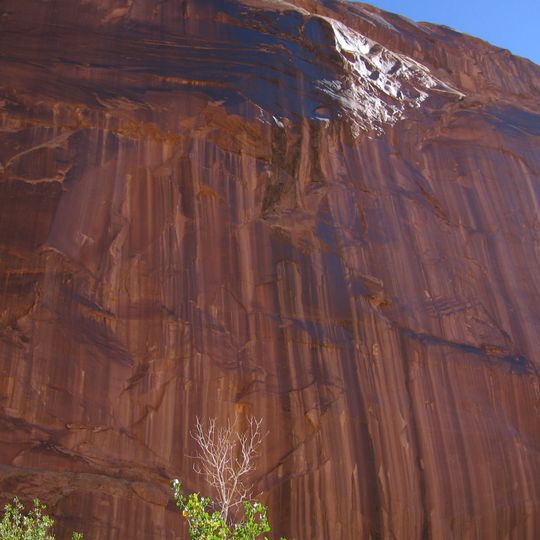
Horseshoe Canyon, Canyon with Barrier Canyon Style rock art in Utah, United States
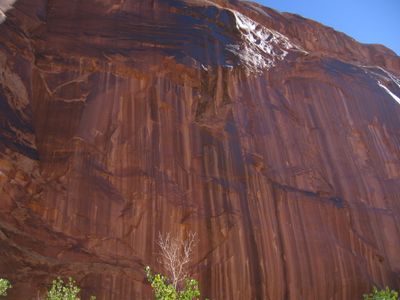
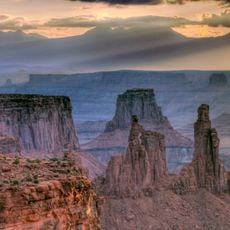
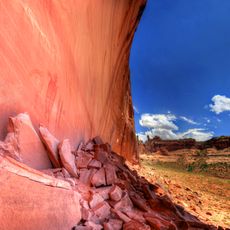
Horseshoe Canyon is a detached unit of Canyonlands National Park in Utah, west of the Green River. Its near-vertical sandstone walls, streaked with dark bands, enclose the Great Gallery: a panel about 200 feet long and 15 feet high with roughly 20 life-sized anthropomorphic figures, the largest over 7 feet tall.
Human use of Horseshoe Canyon dates to 9000–7000 B.C., when Paleo-Indians hunted mastodons and mammoths here. Desert Archaic hunter-gatherers later produced the Barrier Canyon Style art, including the Great Gallery, whose Holy Ghost panel was dated to 400–1100 A.D. through two rockfall events. Fremont and Ancestral Puebloan occupation was brief, and the canyon was abandoned by 1300 A.D. The Great Gallery unit joined Canyonlands National Park in 1971.
Indigenous artists used these rock surfaces to express their understanding of people, animals, and the spiritual world through red ochre pigments. The paintings remain visible today as a direct connection to how people once lived in this desert region.
The trailhead sits on the west rim, reached by 30 miles (48 km) of graded dirt road from State Route 24 or 47 miles (76 km) from Green River; both routes can become impassable when wet. The hike to the Great Gallery is about 6.5 miles (10.5 km) round trip with a 750-foot (228 m) descent, taking 3 to 6 hours. Camping is allowed at the trailhead on BLM land, with a vault toilet but no water; overnight stays inside the park are not permitted.
The human figures in the Great Gallery rank among the largest known prehistoric artworks of this type in North America and create a striking impression. These oversized representations continue to intrigue visitors, raising questions about their meaning and purpose.
The community of curious travelers
AroundUs brings together thousands of curated places, local tips, and hidden gems, enriched daily by 93,845 contributors worldwide.