Keystone Wye, Road interchange in Black Hills, South Dakota
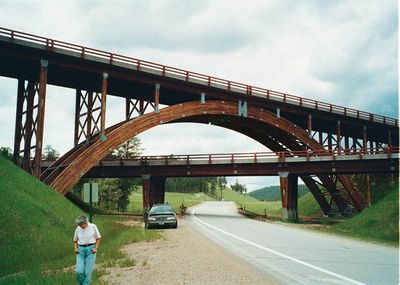
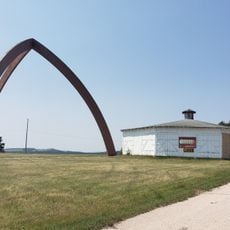
The Keystone Wye is a road interchange in the Black Hills that connects U.S. Route 16 and US 16A using two glued laminated timber arches spanning three levels. The structure uses wooden components to carry traffic across different elevations.
The interchange was built in 1967–1968, when the South Dakota Department of Transportation converted US 16 into a four-lane highway between Rapid City and Keystone. Engineers Clyde Jundt and Kenneth C. Wilson designed the three-level directional T. The name Keystone Wye predates it, going back to Peter Norbeck's 1930s road network for Mount Rushmore and Harney Peak.
The interchange name comes from Senator Peter Norbeck's 1930s road system, which linked tourist destinations like Mount Rushmore and Black Elk Peak. This connection was part of a larger plan to open up the Black Hills to travelers.
The interchange sits in the Black Hills where US 16 meets US 16A; a lay-by off the highway holds historic and scenic information about the area, and an SDDOT maintenance yard and minor connecting roads share the site. US 16A toward Keystone was widened to four undivided lanes in the late 1980s, and US 16 toward Three Forks gained passing lanes in the early 2000s.
Three wooden arch pieces that failed quality inspections were repurposed into a pyramidal sculpture. The artwork was later relocated near the Sitting Bull Crystal Cavern Dance Pavilion.
The community of curious travelers
AroundUs brings together thousands of curated places, local tips, and hidden gems, enriched daily by 94,251 contributors worldwide.