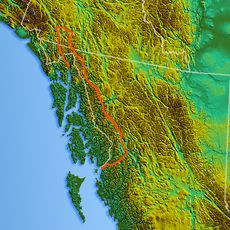
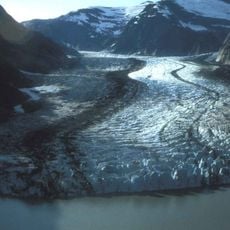
Mount Edziza volcanic complex, Volcanic mountain complex in Stikine Country, British Columbia, Canada.
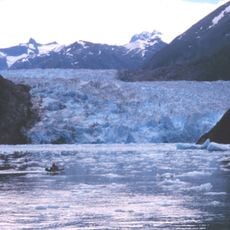
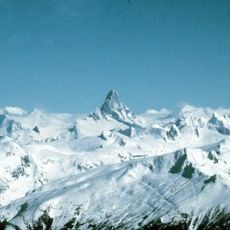
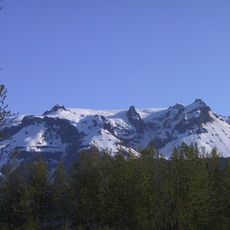
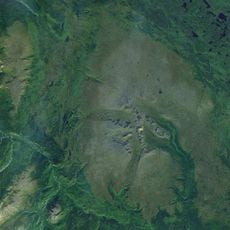
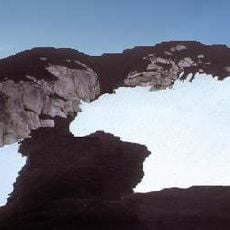
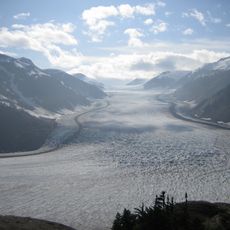
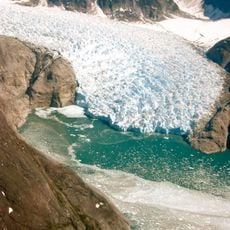
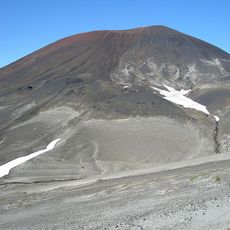
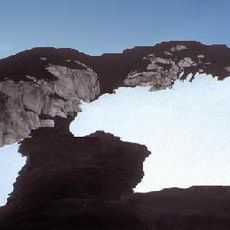
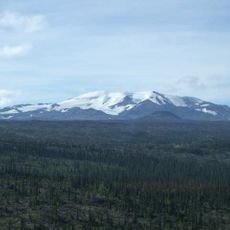
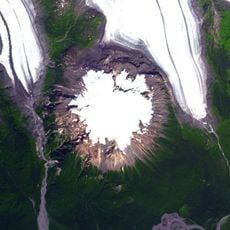
Mount Edziza is the highest summit of the Mount Edziza volcanic complex, an ice-covered stratovolcano rising to 2,786 metres on the Tahltan Highland of northwestern British Columbia. The complex forms an elongated lava plateau about 65 km long and 20 km wide, built from flat-lying basaltic lava flows and topped by an ice cap with outlet glaciers. Its steep sides expose black basalt columns and light-coloured trachyte and comendite rocks.
The complex has grown over the last 7.5 million years through five cycles of magmatic activity spanning four geologic epochs, producing rocks that make up 13 geological formations. The most recent eruptions occurred within the last 11,000 years but remain undated. Activity today is limited to hot springs along the western side.
The name Edziza has several proposed origins: a 1927 survey report by J. Davidson said it means "sand" in Tahltan, referring to the ash and pumice-like sand of the Big Raven Plateau, while a BC Parks brochure gives "cinders". Volcanologist Jack Souther suggested it corrupts Edzerza, a local Tahltan family name.
This location sits in a remote area with no direct road access and requires careful planning before a visit. Travelers should prepare for challenging conditions and research access routes and local conditions in advance.
The complex's 13 geological formations were built over 7.5 million years across five cycles of magmatic activity spanning four geologic epochs. Its most recent eruptions occurred within the last 11,000 years but remain undated; today the only activity is hot springs along the western side.
The community of curious travelers
AroundUs brings together thousands of curated places, local tips, and hidden gems, enriched daily by 95,305 contributors worldwide.