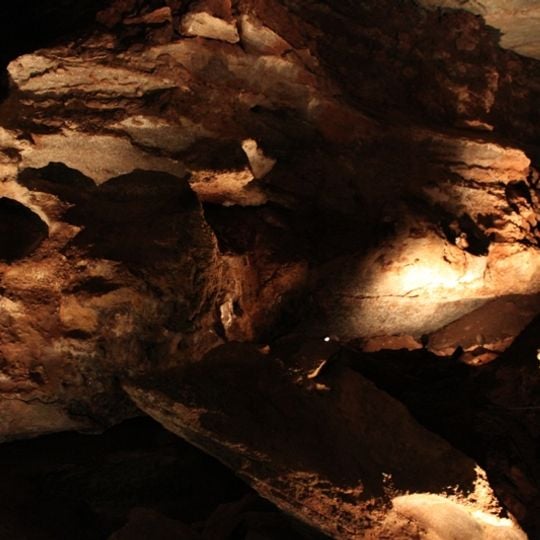
Alabaster Caverns State Park, Natural gypsum cave system in Freedom, Oklahoma.
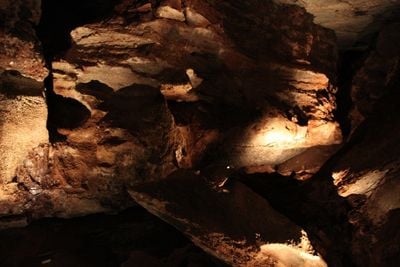
Alabaster Caverns State Park holds the largest natural gypsum cave open to the public, cut through Permian-age rock. The main cavern runs about 0.75 miles (1,210 m) into the formation, roughly 60 feet (18 m) wide and 50 feet (15 m) high, with brown, tan and reddish-brown rock masses, cream patches where light falls, and a large angled slab sloping down at lower centre. It branches into boulder formations and smaller caves, and a small perennial stream flows through it.
Outlaws used the caverns as hideouts in the 19th century, but the first documented exploration came in 1898, five years after Hugh Litton homesteaded the area in 1893. In 1939 Charles Grass bought the land, renovated the caves, opened public tours and gave them their present name. Oklahoma purchased 200 acres from Grass on September 1, 1953, for $34,000, and the site became a state park in 1956.
The cave's chambers carry names used on tours, such as Ship's Prow, Devil's Kitchen and Crystal Vault. Charles Grass, who bought the land in 1939, coined the name Alabaster Caverns. The cave also appears in the 2019 film "The Bygone" and the 2023 film "The Quest for Tom Sawyer's Gold."
Guided tours operate regularly throughout the day and take visitors through the main passages and chambers underground. Wear sturdy shoes with good grip since the cave floor can be damp and uneven in places.
The caverns contain black alabaster, a stone found in only a handful of locations around the world. This rare mineral composition makes the site particularly noteworthy to geologists and those interested in rock formations.
The community of curious travelers
AroundUs brings together thousands of curated places, local tips, and hidden gems, enriched daily by 94,112 contributors worldwide.