Azerbaijan Carpet Museum, Carpet museum in Baku, Azerbaijan
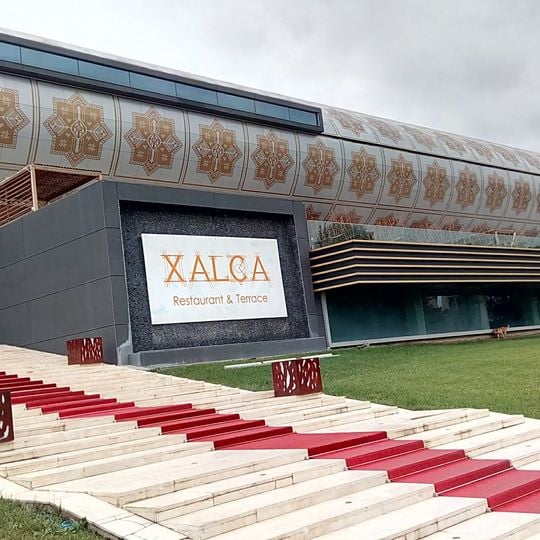
The Azerbaijan Carpet Museum is an art museum in Baku dedicated to the collection and display of carpets from the region. The building itself is shaped like a rolled carpet, with curved walls and sloped surfaces covered in glass and metal panels.
The museum was created by a decree of the Council of Ministers of the Azerbaijan SSR on 13 March 1967, initiated by carpet scholar Latif Karimov. Its first exhibition opened on 26 April 1972 in the 15th-century Juma Mosque in Icheri Sheher, with Heydar Aliyev attending. In 1992 it moved to the former Lenin Museum, and on 26 August 2014 it opened in a new building on the Baku seafront.
The museum's name honours Latif Karimov, the carpet designer and scholar who led its early collecting expeditions and wrote the fundamental work "Azerbaijan Carpet". Its seven collections cover pile and flat-woven carpets, textiles, costume, embroidery, metalwork, ceramics, glass, wood, paper and jewellery. A 19th-century Salyan Khilasi from Shirvan and a late 17th-century Ajdahali (Dragon) carpet from Karabakh came as a 2013 donation from Beverly Schiltz of Chicago.
The museum stands in the Baku seafront park, a short walk from Neftchiler Avenue and Icheri Sheher. Its entrance faces the Caspian, and the building's curved form is visible from the boulevard. The collection is displayed across three floors, with the main carpet halls on the upper levels.
The building was designed by Austrian architect Franz Janz, and its unusual configuration is meant to resemble a rolled carpet. Construction began with a foundation ceremony on 15 May 2008 in the Seaside National Park, attended by UNESCO Director-General Koichiro Matsuura, and the museum opened on 26 August 2014.
The community of curious travelers
AroundUs brings together thousands of curated places, local tips, and hidden gems, enriched daily by 93,397 contributors worldwide.