Emperor's Mosque, Ottoman mosque in Stari Grad, Bosnia and Herzegovina
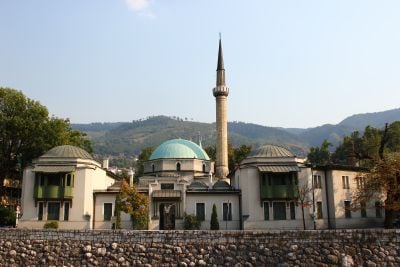
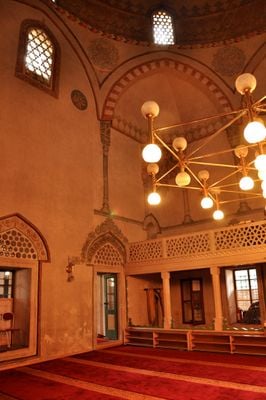
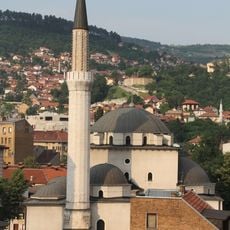
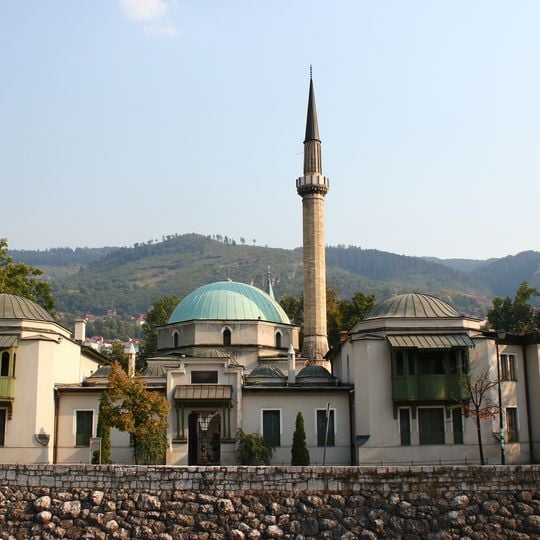
The Emperor's Mosque is a stone and plaster complex in Sarajevo with a pale green central dome on a light cubic base, flanked by two lower domes and a slender stone minaret with a conical cap on the right. Inside, ochre plaster walls frame pointed arches with carved stone surrounds, a wooden gallery balustrade, and a brass chandelier with white glass globes.
Construction began in 1457 under the direction of Isa Bey Ishakovic and marked the start of Sarajevo's urban growth. A significant reconstruction took place in 1565, after which it received dedication to Sultan Suleiman the Magnificent.
The mosque is also called Careva džamija, "the Emperor's Mosque", after Mehmed the Conqueror, to whom its founder Isa-beg Isaković dedicated it. The graveyard behind the prayer hall holds tombstones from the 15th to the 19th century, and two archaic nišans behind the mihrab are thought to mark the grave of Isa-beg, the founder of Sarajevo. Until 2022 the office of the reis-ul-ulema, head of the Islamic Community, was housed within the mosque complex.
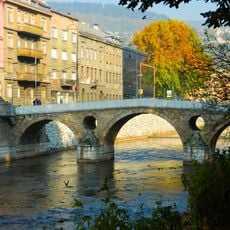
The mosque stands in Sarajevo's Stari Grad, beside the Miljacka and the Emperor's Bridge that Isa-bey built to lead to it. The prayer hall is in use for the five daily prayers and the Friday noon prayer, so visitors come between them. The graveyard behind the mosque, with tombstones from the 15th to 19th centuries, can be walked through from the outside.
The original complex included a public bath and a bridge alongside the mosque, forming the heart of Sarajevo's earliest neighborhoods. This combination reveals how essential the site was to the city's early expansion.
The community of curious travelers
AroundUs brings together thousands of curated places, local tips, and hidden gems, enriched daily by 94,191 contributors worldwide.