Arslanagića Ćuprija, Ottoman bridge in Trebinje, Bosnia and Herzegovina.
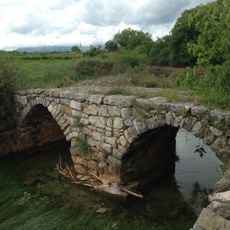
Arslanagića Ćuprija is a stone bridge over the Trebišnjica with two large and five smaller arches, carried on three river piers. Its roadway is 3.60 m wide and the larger arches rise 15 m above normal water level; the sides are edged with stone-slab corbels. A massive central pier, about 3.60 m wide and 9 m long, divides the spans in a 1:2:2:1 rhythm.
Dubrovnik archive records show construction began in 1568 with ten local masons, and the bridge opened in 1574 under Mehmed-Pasha Sokolović. It carried almost all trade, mostly salt, between central Bosnia and Novi (Herceg Novi). After Venice took Novi in 1687, wealthy Muslims withdrew to Trebinje and the crossing lost importance.
The bridge takes its name from Arslan-Aga, a toll collector who lived here after Turkish families settled in Trebinje following their withdrawal from Herceg Novi in 1687. This name still recalls the practical role the crossing played in daily commerce.
The bridge is located about 1.2 kilometers from central Trebinje and is easily accessible on foot. The area around it is open to the public and offers good views of the river landscape and surrounding districts.
The bridge was dismantled stone by stone in 1966 and stored on a nearby field; the reconstruction was designed by Energoinvest of Sarajevo. Blocks were numbered and transported by boat, and the bridge reopened in 1970 at Gradina, several kilometres downstream. Legend holds that Canada made an offer to buy it.
The community of curious travelers
AroundUs brings together thousands of curated places, local tips, and hidden gems, enriched daily by 93,365 contributors worldwide.