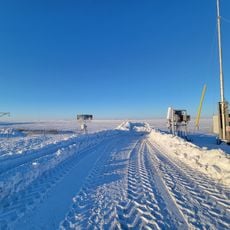
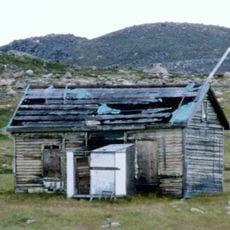
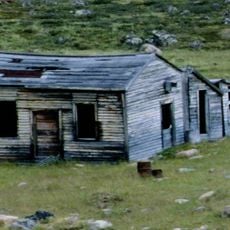
Cambridge Bay LORAN Tower, Navigation tower in Cambridge Bay, Canada.
The Cambridge Bay LORAN Tower was a 189 m (620 ft) free-standing lattice tower, four-sided with an 18 m (59 ft) base per side, near Cambridge Bay, Nunavut. It transmitted LORAN signals and later served as a non-directional beacon on 245 kHz with 2,000 watts, identifying as "CB" in Morse code. Its apparent guy-wires were top-loading elements of the antenna.
Built in 1947/48 for LORAN transmissions, the 189 m lattice tower stood as Canada's tallest freestanding structure for several years. It later served as a non-directional beacon known as "CB", transmitting Morse code on 245 kHz at 2,000 watts. The tower became redundant with the Distant Early Warning Line in the 1950s. Declared structurally unsound in 2013, it was demolished on 4–5 August 2014 and replaced by a 49 m tower.
The tower's nickname, the "CB" beacon, came from the Morse code letters it transmitted on 245 kHz. Local residents and pilots used the callsign to identify the signal, and the tower remained a known landmark until its demolition in August 2014.
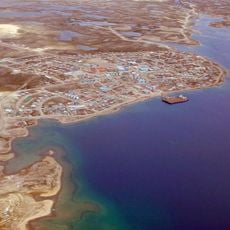
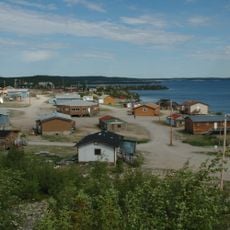
The tower no longer stands: it was demolished on 5 August 2014, so there is no structure to visit at the site. Cambridge Bay is reached by air, and the former tower site lies near the community. Plan around Arctic daylight and weather rather than expecting an intact landmark.
The elements that appeared to be supporting guy-wires actually functioned as top-loading components of the antenna system. This clever design detail was integral to how the structure transmitted its navigation signals across the Arctic.
The community of curious travelers
AroundUs brings together thousands of curated places, local tips, and hidden gems, enriched daily by 93,033 contributors worldwide.