Zhang Fei Temple, Temple complex in Yunyang County, China
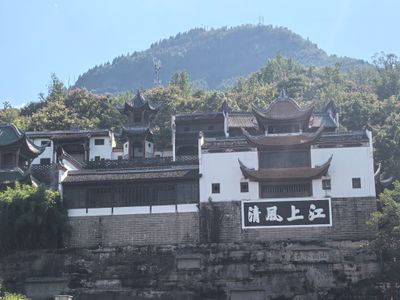
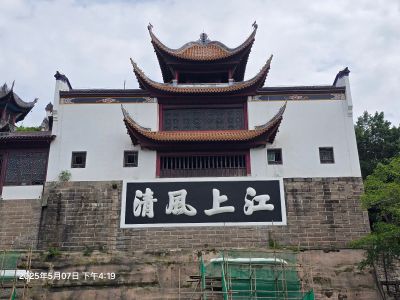
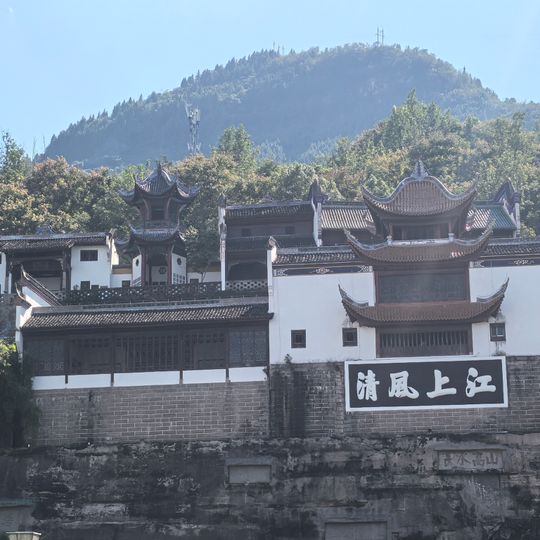
Zhang Fei Temple is a temple complex on Feifeng Mountain along the south bank of the Yangtze River in Yunyang County, featuring traditional architectural elements from southwestern China. The buildings spread across several levels of the mountain slope, combining stone walls, wooden structures, and decorative roof design in classical Chinese style.
The temple was first built at the end of the Shu Han period, over 1,700 years ago, on the south bank of the Yangtze at the foot of Feifeng Mountain opposite the old Yunyang county town, to honour the Three Kingdoms general Zhang Fei. During the Cultural Revolution its clay statues were destroyed; a new Zhang Fei statue was installed in 1981. Because the Three Gorges project put the lowest point of the site at only 330 metres above sea level, the complex was moved to Long'an village in Panshi town, and the main works were finished in June 2003, opening to visitors on 19 July 2003.
The temple is a combined civil and military shrine: the main hall, side hall, Jieyi Tower, Wangyun Pavilion and Zhufeng Pavilion honour Zhang Fei, while the Dujuan and Deyue pavilions commemorate the Tang poet Du Fu, who stayed here two years. A folk saying holds that Zhang Fei's body lies in Langzhong, his head in Yunyang. The Niangniang Hall, dedicated to his wife Xiahou, was rebuilt during the relocation.
The temple now stands at Panshi Town, Long'an Village, on the south bank of the Yangtze, still facing the new Yunyang county seat across the river. The site was chosen because its terrain resembles the original Feifeng Mountain slope. It opened to visitors on 19 July 2003, after the main works finished in June 2003.
The temple was the largest above-ground heritage relocation in the Three Gorges reservoir area, moved whole to Long'an Village in Panshi Town on the south bank, still facing the new Yunyang county seat across the river. Workers used the original building materials wherever possible, adding only supplementary ones, and took the chance to rebuild the Niangniang Hall that had been renamed a side hall after 1981.
The community of curious travelers
AroundUs brings together thousands of curated places, local tips, and hidden gems, enriched daily by 92,789 contributors worldwide.