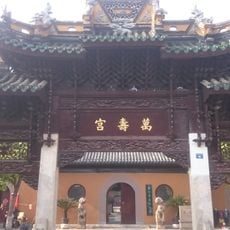
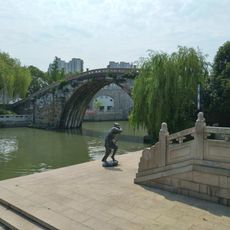
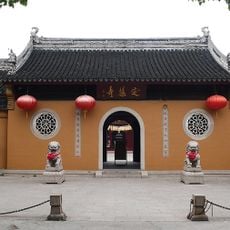
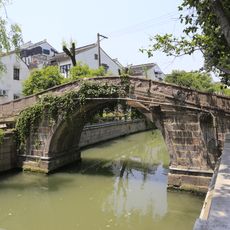
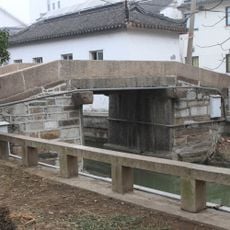
Pan Gate, Ancient water and land gate in Suzhou, China
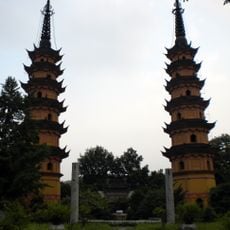
Pan Gate is an ancient structure in Suzhou that controlled both water and land routes into the city, featuring a double-gate building, the Ruiguang Pagoda, and a stone bridge over the canal. The design allowed boats to pass beneath while pedestrians and vehicles used the level above.
A gate has stood here since Wu's city wall was built in 514 BC, when it was the only entrance to the city. It was first called Panmen because a wooden coiled dragon hung on it to overawe the southern state of Yue. The present structure dates to 1351, under the Yuan emperor Ukhaatu Khan, and Zhang Shicheng added the barbican in 1356.
The name Panmen comes from the winding course of the water and land passages, and earlier the gate was called Panmen, "Coiled Dragon Gate", after a wooden coiled dragon hung on it to overawe the state of Yue to the south. The gate stands at the southwest corner of the old city, where the inner canals meet the defensive moat and the Grand Canal.
Public buses serve the Pan Gate Scenic Area with stops near the northern entrance, making it easy to arrive. The entire complex is walkable with clear paths connecting the different structures on the grounds.
The gate features two separate traffic levels within a single structure, a design that served both boat traffic and wheeled carts simultaneously, reflecting the commercial importance of water and land routes in ancient times. This dual-level engineering solution remains one of its most distinctive architectural achievements.
The community of curious travelers
AroundUs brings together thousands of curated places, local tips, and hidden gems, enriched daily by 94,114 contributors worldwide.