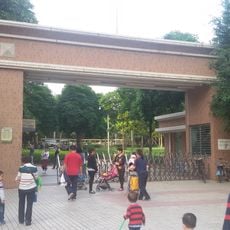
Nanhai God Temple, Maritime temple in Huangpu District, China.
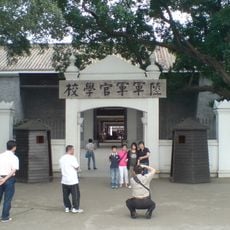
The Nanhai God Temple faces south on a 30,000-square-metre site in Miaotou, Huangpu, built in Ming style. Five halls rise along a central axis — Head Gate, Ceremonial Gate, Rites Pavilion, Main Hall and Zhaoling Palace — each higher than the last, with side structures arranged symmetrically. The Main Hall, rebuilt in 1989, has green glazed tiles and a ridge with two dragons contesting a pearl.
Founded in 594, the 14th year of the Sui Kaihuang era, the temple was expanded under the Tang and repaired or enlarged in the Song, Yuan, Ming and Qing dynasties. Tang Xuanzong honoured the Nanhai god as Guangli Da Wang, and Song and Yuan rulers added titles. In 1966 the hall was destroyed and most steles smashed; rebuilding began in 1986 and the wooden hall was completed in 1989.
The temple serves as a gathering place where fishing communities and merchants make offerings and prayers for protection at sea. Throughout the year, visitors can witness people lighting incense and participating in ceremonies that honor the maritime traditions of the region.
The temple is easily reached by metro, with Nanhai God Temple station providing direct access to the site. Visitors should dress respectfully and observe quietly during ceremonies to avoid disrupting the prayers of worshippers.
The temple's popular name, Boro Temple, comes from a legend that the Indian minister Daxisi Sima planted a boro tree here in 647; the tree was later worshipped as a deity. The Pearl River in front of the temple was accordingly called the Boro River.
The community of curious travelers
AroundUs brings together thousands of curated places, local tips, and hidden gems, enriched daily by 93,847 contributors worldwide.