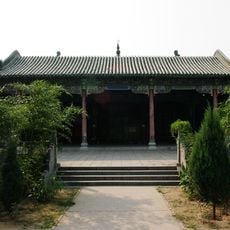
Tomb and temple of Taihao, Ancient temple complex in Huaiyang District, China
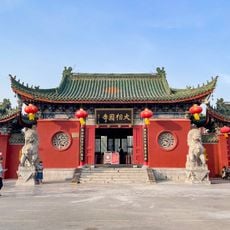
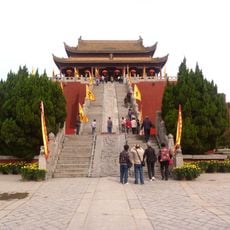
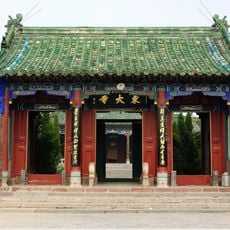
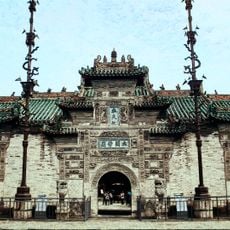
The Tomb and Temple of Taihao form a large complex in Huaiyang District featuring palace-style buildings decorated with green and gold accents throughout the structures. The grounds lie along the water landscape between Gucai River and Chenghu Lake.
Written records of sacrifices at the site begin in the Tang and Song periods: in 630 the Tang court banned grazing in the tomb area, and in 960 the Song established caretaker households. In 966 Emperor Taizu ordered a temple built and fixed spring and autumn rites. The Ming rebuilt it from 1448, when prefect Zhang Zhidao added the sleeping hall, corridors and halberd gate, shaping today's layout.
The temple's main hall, Tongtian Dian, houses a statue of Fuxi; behind it, Xianren Dian is dedicated to Nüwa. The halls are named after concepts from the Yijing, such as Xiantian, Taiji, Liangyi, Sixiang and Bagua. The temple fair, held from the second day of the second lunar month to the third day of the third month, features the dance Danjingtiao and painted clay toys called niniigou, listed as national intangible heritage in 2014.
The complex covers about 875 mu (roughly 58 hectares) and runs about 750 metres along a north–south axis, entered from the south across the Dushan Bridge over the Cai River. The gates line up so that ten successive doorways frame one another along the axis. Allow time to walk the nine courtyards; the tomb mound and the yarrow garden lie at the far northern end.
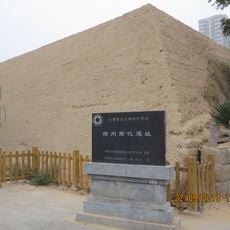
The tomb mound stands 13.5 m high, with a round top on a square base whose perimeter exceeds 200 m. Pine and cypress grow around it, and the蓍草园 behind the mound is planted with yarrow, the stalks used in the I Ching divination that tradition links to Fuxi.
The community of curious travelers
AroundUs brings together thousands of curated places, local tips, and hidden gems, enriched daily by 94,536 contributors worldwide.