Hailuogou Glacier, Glacier in Luding County, Sichuan, China.
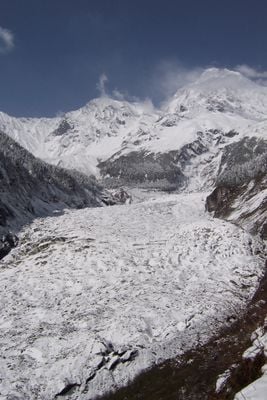
Hailuogou Glacier is a 14.4 km valley glacier in Conch Gully, Luding County, Sichuan, descending from Mount Gongga. Its upper accumulation basin lies above 4,900 m, feeding a 1,080 m-high icefall between 3,800 and 4,900 m. Below, the 5.7 km ice tongue reaches down to about 2,940 m, ending among firs. The surface shows crevasses, ice arches and scattered dark debris.
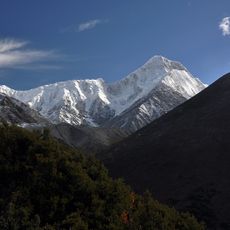
Hailuogou Glacier descends from the main peak of Mount Gongga in the Daxue Mountains; the English Wikipedia states it formed 16 million years ago. In February 2017 the park was listed as a 5A-level tourist attraction. On 5 September 2022 a magnitude-6.8 earthquake struck Luding County, killing three park employees and trapping 219 visitors for more than 50 hours before their rescue.
Hailuogou means "Sea Conch Ravine" in Chinese, and in Tibetan the valley is Dungkar Lungpa, "white conch valley". The name refers to the gully itself, not to a spiral shape in the ice. The conch is a Buddhist symbol of the spoken word, and the valley lies in Garzê Tibetan Autonomous Prefecture.
The glacier is reached through Moxi Town, which requires several hours of travel from the nearest major city. The best time to visit is from autumn through spring, when conditions are most favorable for exploration.
The icefall drops 1,080 metres over a width of 500 to 1,100 metres, which Chinese sources describe as the largest icefall yet found in the country. The glacier's tongue ends at about 2,940 metres and pushes 5.3 kilometres into a forest of Emei fir, so ice and trees meet directly.
The community of curious travelers
AroundUs brings together thousands of curated places, local tips, and hidden gems, enriched daily by 93,923 contributors worldwide.