Site of Nanyue Kingdom Palace, Archaeological site in Guangzhou, China
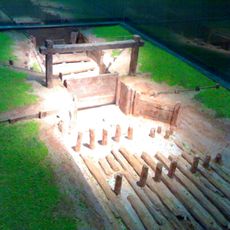
The Site of Nanyue Kingdom Palace is an archaeological location in central Guangzhou covering thousands of square meters with palace foundations, ancient wells, and garden remains. The excavations reveal building patterns and layouts from different time periods layered over the same ground.
The palace was established in the early years of the second century before Christ and functioned as a ruling center until a major invasion from the north transformed the region. The conquest brought new forms of governance and ended the kingdom's independence.
The site's name in Chinese, Nanyue guo gongshu yizhi, refers to the palace offices of the Nanyue kingdom, the state ruled from Panyu (present-day Guangzhou) by the Triệu/Zhao line. The excavated stone columns, beams, walls and doors are unusual because Chinese ancient architecture relied mainly on timber, while stone construction is associated with the West; archaeologists describe the complex as a "stone city" with structures resembling Roman-era building. The remains were voted among China's top ten national archaeological discoveries in 1995 and 1997.
The excavated area open to visitors is only about 350 square metres, a southeastern corner of the Children's Park in Guangzhou, where parts of Palace No. 1 and a corner of Palace No. 2 have been uncovered. The richest remains lie buried beneath more than 200,000 square metres still unexcavated. Expect to see the dig itself rather than a finished complex.
Only a corner of Palace No. 1 and part of Palace No. 2 have been excavated: about 350 square metres in the southeast corner of Guangzhou Children's Park. Archaeologists estimate that more than 200,000 square metres of the palace complex still lie underground.
The community of curious travelers
AroundUs brings together thousands of curated places, local tips, and hidden gems, enriched daily by 94,003 contributors worldwide.