Ruiyun Pagoda, Stone pagoda in Fuqing, China
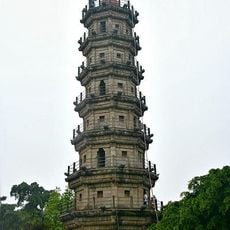
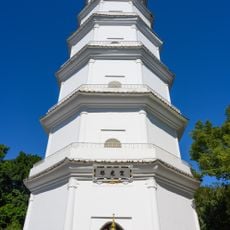
Ruiyun Pagoda is a seven-storey octagonal granite tower built in 1606–1615 in Fuqing, Fujian. It stands 34.6 metres tall on a 24-metre-perimeter sumeru base. The first storey has a north door with a stone plaque reading "Lingxiao Yuzhu" and seven Buddha niches; upper storeys have north and south doors. A stone stairway climbs the hollow interior to a gourd-shaped finial.
Ruiyun Pagoda was built between 1606 and 1615, in the 34th to 43rd years of the Wanli reign of the Ming dynasty. It was sponsored by Ye Chengxue, son of the grand secretary Ye Xianggao, and the county magistrate Ling Hanliao. According to legend, five-coloured auspicious clouds appeared when the foundation site was divined, giving the pagoda its name. It was listed as a Fujian provincial cultural relic in 1961.
The name Ruiyun means "auspicious clouds", from the legend that five-coloured clouds appeared when the foundation site was divined. The first storey's north door carries a stone plaque inscribed "Lingxiao Yuzhu" (Jade Pillar Reaching the Sky). Look for the 400-plus reliefs of monks, Buddhas, animals and plants, and the 12 surviving door guardians.
The pagoda stands in the urban area of Fuqing, not on Ruiyan Mountain; it is reached on foot from the surrounding streets. The hollow interior has a stone staircase to the top, and the first-floor door faces north beneath the "Lingxiao Yuzhu" stone plaque.
The pagoda's name comes from a legend: when the foundation was being chosen, five-coloured auspicious clouds appeared in the sky. The structure has 400 relief carvings, from 20 cm to 1.5 m tall, including 12 surviving door guardians and 48 generals on the eaves.
The community of curious travelers
AroundUs brings together thousands of curated places, local tips, and hidden gems, enriched daily by 93,086 contributors worldwide.