Bao'en Dingguang Duobao Pagoda, Buddhist pagoda on Yu Hill in Fuzhou, China.
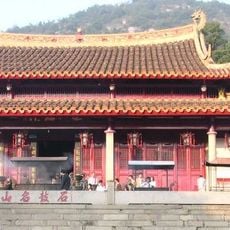
The Bao'en Dingguang Duobao Pagoda, commonly called the White Pagoda, is a seven-storey, octagonal pavilion-style pagoda standing 41 metres tall on the western slope of Yu Hill behind Wansui Temple. Its brick core is clad in timber, and the walls and door faces are painted with golden Buddhas. A seven-tiered octagonal gourd-shaped finial crowns the top, and a suspended stair inside allows visitors to climb to the summit.
Wang Shenzhi, later founder of Min, built the pagoda in 904 Tang times to gain merit for his parents; a pearl found during excavation gave it the name Dingguang Duobao. A temple, Baita Temple, followed a year later. Lightning fire destroyed it in 1534, and the 1548 Ming rebuilding replaced the brick core with a brick body and added a seven-tiered octagonal gourd finial.
The full name, Bao'en Dingguang Duobao Pagoda, combines "repaying gratitude" (bao'en) with "Dingguang" and "Duobao", the latter two drawn from the names of buddhas. According to the source, Wang Shenzhi built it in 904 to deliver the souls of his parents, and a pearl found while digging the foundations gave the pagoda its name. Its common name, White Pagoda, comes from the white lime wash on its plain exterior.
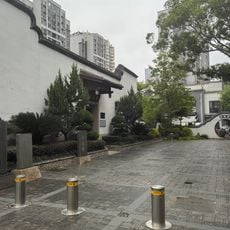
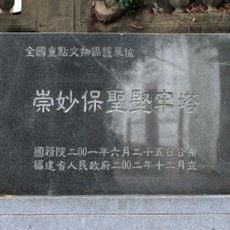
This pagoda sits on Yu Hill and is protected as a provincial cultural site. You can approach it from the base of the hill where the local layout guides you toward the structure.
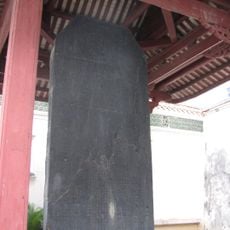
The white lime coating that gives the pagoda its popular name "White Pagoda" is not its only surface detail: the walls and door faces are painted with golden Buddha figures. Look for the 15 Tang-dynasty bluestone carvings of the sumeru base, showing sea-country myths, lions and peonies, set upright in place during the 1963 clean-up of the surroundings.
The community of curious travelers
AroundUs brings together thousands of curated places, local tips, and hidden gems, enriched daily by 93,989 contributors worldwide.