Ruiyan Mile Statue, Buddhist statue in Fuqing, China
The Ruiyan Mile Statue is a 9-metre-high stone carving of Maitreya on the eastern slope of Ruiyan Mountain in Haikou Town, Fuqing, Fujian. The figure sits cross-legged, bare-chested and bare-bellied, wearing a monk's robe, with a bead string in its left hand and its right hand on its belly; three small arhats are carved beside its waist and crossed legs. The base is 8.9 metres wide.
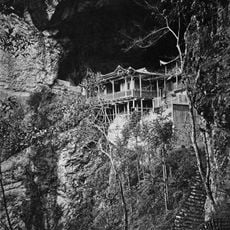
Carving began in 1341, the first year of the Yuan Zhizheng era, and was finished in 1368, the first year of Ming Hongwu. In 1390 a Buddha pavilion was built over the statue; rebuilt in 1583 as the Mile Pavilion, it was restored with funds raised by the minister Ye Xianggao in 1620, who added a Kuixing Tower, and the pavilion burned down in 1862. Only ten stone pillars and three steles remain; the site was listed as a county-level protected unit in 1981 and a national one in 1996.
The statue's name comes from Ruiyan Mountain, on whose eastern slope it was cut; locals call the figure the largest Yuan-era Maitreya in China. Around it stood a protective pavilion, rebuilt in 1583 as the Mile Pavilion and again in 1620 by the minister Ye Xianggao, who added a Kuixing Tower and renamed it Shifo Pavilion. The pavilion collapsed in 1862; ten stone pillars and three steles remain.
The statue sits on the eastern slope of Ruiyan Mountain in Haikou Town, Fuqing; reach Haikou first, then follow the paths up the hillside. The protective pavilion that once covered the figure is gone, so the carving stands in the open; only ten stone pillars and three steles remain around it.
The statue is not a single figure: three small arhats are carved beside it, between the waist and the crossed legs. The stone pillars and three steles standing nearby are all that remain of the pavilions that once sheltered the carving, destroyed in 1862.
The community of curious travelers
AroundUs brings together thousands of curated places, local tips, and hidden gems, enriched daily by 94,981 contributors worldwide.