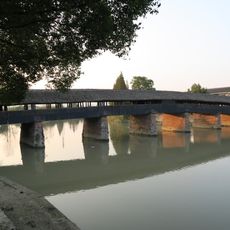
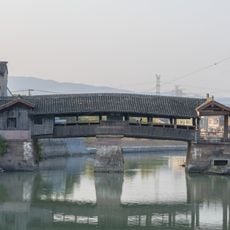
Guangji Bridge, Fenghua, Stone bridge in Fenghua, China.
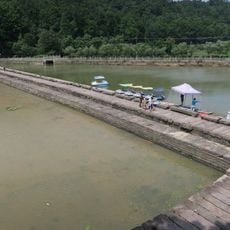
Guangji Bridge is a covered wooden-and-stone bridge over the Xian River in Nandu village, Fenghua. It has four spans and rises slightly at the centre; it is 51.68 m long and 6.6 m wide. Each of the four piers is made of six stone slabs driven into the riverbed in a trapezoid and fixed with mortise-and-tenon joints, carrying wooden beams, a plank deck and a 22-bay post-and-beam gallery.
Nandu was a relay station on the official road from the Tang dynasty, named for the ferry crossing the Xian River. A monk, Shiwu, built an earth bridge in 961; Yu Tan rebuilt it in wood, and Wang Mi, magistrate of Fenghua, enlarged it in 1051. In 1192 Wang Ji rebuilt it with stone piers and a covered gallery. In 1286 Lu Zhen rebuilt it with funds from Shen Sen and mason Xu Cheng of Yinxian; the piers remain Yuan work.
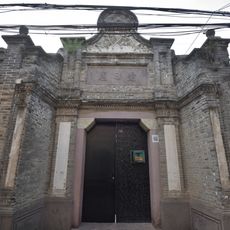
The name Nandu, meaning "south crossing", comes from the ferry that once carried travellers over the Xian River. The bridge has 22 gallery bays, and its two ends hold tea and stele pavilions with five inscriptions, including bridge-building records, prohibitions and tea donations. The Southern Song poet Zhang Liangchen wrote "Morning Walk at Nandu" here.
The bridge can be walked across easily, allowing visitors to view the craftsmanship and structure from up close. It is well accessible in the area, so it makes sense to spend time for a slow and attentive walk.
Each of the four piers is not a solid masonry block but six long stones driven into the riverbed in a trapezoid and locked with mortise-and-tenon joints, which narrows the surface facing the current. The third pier's stone column carries an inscription dated the 29th day of the fourth month of 1286, naming the mason Xu Cheng of Xiaoxi in Yinxian.
The community of curious travelers
AroundUs brings together thousands of curated places, local tips, and hidden gems, enriched daily by 94,528 contributors worldwide.