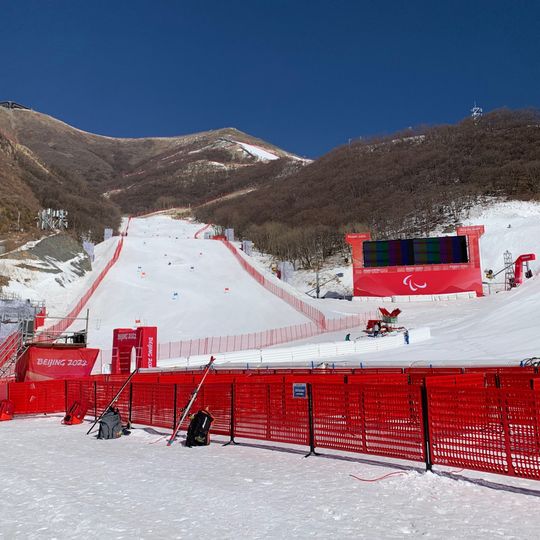
National Alpine Skiing Centre, Alpine ski venue in Yanqing District, Beijing, China.
The National Alpine Skiing Centre lies in forest at 1,200 m on Xiaohaituo, the "Small Haituo" peak of the Haituo massif in Yanqing District, about 90 km northwest of central Beijing. Its trails total 10 km, including seven race courses; the downhill named "The Rock" starts at 2,179 m and finishes at 1,285 m after 2,950 m, with four jumps of up to 60 m. The courses reach inclines of 68% and the vertical drop is about 900 m, the largest of any ski area in China.
Built for the 2022 Winter Olympics alongside the Yanqing National Sliding Centre, the centre opened in 2019. Its downhill course was designed by Swiss Olympic downhill champions Bernhard Russi and Didier Défago. In 2015 the boundary of the Beijing Songshan National Nature Reserve was adjusted to allow construction, which drew criticism. A planned FIS World Cup race in February 2020 was cancelled because of COVID-19, so athletes first met the course the week before the Games.
The centre is named after Xiaohaituo, the "Little Haituo" peak of Haituo Mountain. Its downhill course, called "The Rock", was designed by Swiss Olympic downhill champions Bernhard Russi and Didier Défago, who built four jumps with gaps of up to 60 metres into the piste.
The resort lies in forest at 1,200 m and is reached by the Yanqing branch of the Beijing–Zhangjiakou intercity railway, about 90 km northwest of central Beijing. The downhill course starts at 2,179 m and finishes at 1,285 m after 2,950 m, a drop of roughly 900 m. Snow is almost entirely artificial, as the area receives only about 5 cm a year.
The downhill course, called "The Rock", was designed by Swiss Olympic downhill champions Bernhard Russi and Didier Défago, who built four jumps with gaps of up to 60 metres into it. The course starts at 2,179 m and finishes at 1,285 m after 2,950 m of racing.
The community of curious travelers
AroundUs brings together thousands of curated places, local tips, and hidden gems, enriched daily by 94,004 contributors worldwide.