Marienkirche, Lutheran church in central Dortmund, Germany.
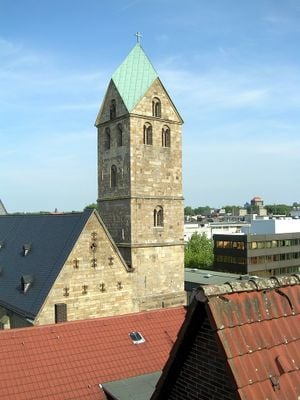
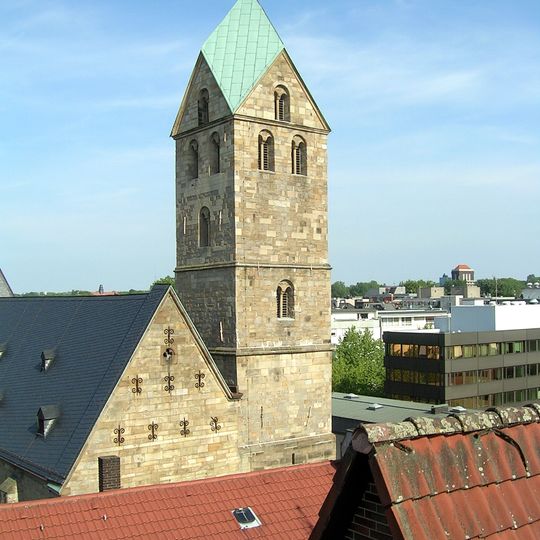
Marienkirche is a church on the Hellweg in Dortmund's inner city, south of the Reinoldikirche. It was built between 1170 and 1200 as a late Romanesque pillared basilica with a pair of west towers and no transept. In the mid-14th century the three Romanesque apses were replaced by a larger Gothic choir; Romanesque elements survive in the south aisle. The square tower is of light brown sandstone blocks, with paired round-arched windows above single ones and a flat green roof.
Built between 1170 and 1200 as a late Romanesque pillar basilica with twin west towers, the church was first documented in 1267 and called Capella Regis until the 14th century, reflecting its link to the royal palace. In the 13th century the town council took over royal rights, making it the council church. Around 1350 the Romanesque apses were replaced by a Gothic choir. After the Reinoldikirche tower collapsed, the north tower was demolished in 1805; the church was closed in 1828 and slated for demolition as a quarry in 1834, but Karl Friedrich Schinkel's expert opinion and Crown Prince Friedrich Wilhelm IV secured its preservation. Rebuilding was completed in 1959 after World War II bombing.
The church keeps two medieval altarpieces: the Berswordtaltar, named after its patron and dated 1385, whose central panel of 1397 shows the Swoon of the Virgin, and the Marienaltar of 1420 by Conrad von Soest with scenes from Mary's life. In 1720 a new reredos was fitted and the Marienaltar panels were cut down, losing over half of the central panel.
The church stands on the Ostenhellweg south of the Reinoldikirche, in Dortmund's inner city. It is an active Lutheran parish church, so visits are best planned around services; the building also hosts concerts of sacred music. The two medieval altarpieces, the Berswordtaltar and the Marienaltar, are inside and can be viewed during a visit.
The two medieval altarpieces survived World War II because they had been moved to Cappenberg Castle at the start of the war; the church itself was almost completely destroyed by bombs and rebuilt by 1959. The organ, set high above the nave as a swallow's nest, was rebuilt in its old position by Steinmann Orgelbau.
The community of curious travelers
AroundUs brings together thousands of curated places, local tips, and hidden gems, enriched daily by 94,233 contributors worldwide.