Museum für Kunst und Kulturgeschichte, Art Deco museum in Dortmund, Germany
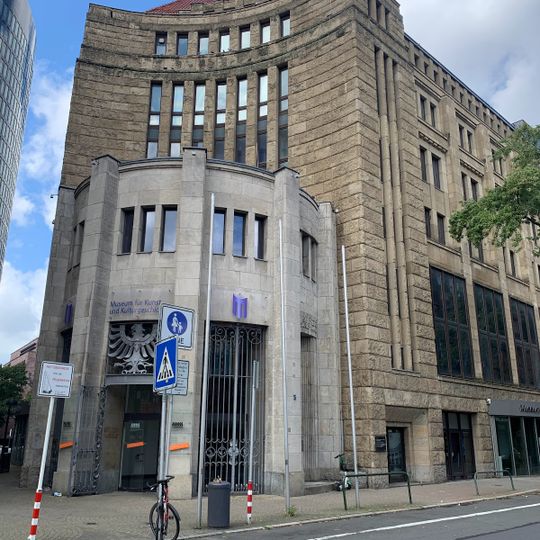
The Museum für Kunst und Kulturgeschichte is an art museum in Dortmund, housed in a former bank building from 1924, displaying paintings, sculptures, and applied arts from different periods. The building itself is listed as an architectural heritage monument in North Rhine-Westphalia and is one of the few surviving examples of Art Deco civic architecture in the region.
The museum was founded in 1883, making it one of the oldest art institutions in the Ruhr area. During World War II, the collection was moved to Cappenberg Castle to protect it from destruction, where works from Westphalian churches were also kept for safety.
The museum's name dates from World War II, when the evacuated collection was kept at Cappenberg Castle. Its workshop there restored and studied church art rescued from bombed Westphalian churches, including Conrad von Soest's Mary Altar from St. Mary's Church in Dortmund. A permanent display by the Förderkreis Vermessungstechnisches Museum shows rare geodetic instruments.
The museum occupies the former Dortmund Savings Bank on Hansastraße, an Art Deco building of 1924 that is a listed monument. The collection is arranged chronologically, from prehistory and antiquity to the 20th century, so follow the sequence to keep the visit coherent. A separate permanent display of the surveying museum shows geodetic instruments. The Deutsches Kochbuchmuseum at Ostwall 60 is run as a branch of the MKK.
The museum contains a section called Die kleine Nationalgalerie, which operates as an outpost of Berlin's Alte Nationalgalerie. This means that works from one of Germany's most prominent national collections can be seen in Dortmund without traveling to the capital.
The community of curious travelers
AroundUs brings together thousands of curated places, local tips, and hidden gems, enriched daily by 94,252 contributors worldwide.