Roter Sand, Lighthouse in North Sea, Germany
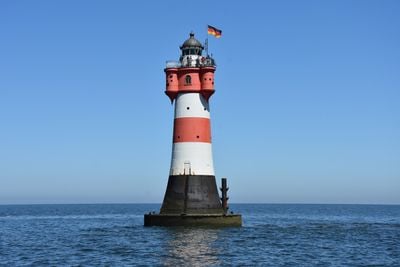
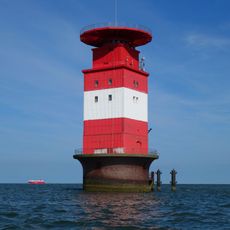
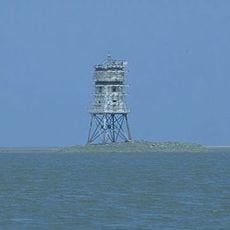
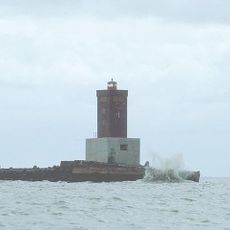
Roter Sand is a 52.5-metre lighthouse in the North Sea, in the Weser estuary. Its cylindrical foundation protrudes 1.5 metres above the water at low tide; above it the tower tapers conically, painted white-red-white-red-white over a black base, with the entrance at the lower rim of the lowest white band. Inside, a storage room, sleeping room, kitchen with coal oven and a service room with three oriel windows lead to a balcony around the lantern; the higher oriel blocks a full circuit.
Built in 1885, this lighthouse was the first building constructed directly on the North Sea floor using a steel caisson foundation. This construction method represented a major advance in maritime engineering during the 19th century.
The tower's five paint bands mark its five interior floors, and the entrance sits at the lower rim of the lowest white band. Its three oriel windows, facing northwest, south and northeast, once held subsidiary lights; the tallest oriel still blocks a full circuit of the balcony. Since 2010 it has been a Historical Landmark of Civil Engineering in Germany.
The lighthouse is accessible only by boat from Bremerhaven port, with travel times varying depending on weather conditions. During summer months, overnight accommodations allow visitors to experience maritime life directly.
The tower's balcony does not run all the way around the lantern: the tallest of the three oriel windows blocks the walkway at one point, so a full circuit is impossible. The oriels once held the minor lights, facing northwest, south and northeast.
The community of curious travelers
AroundUs brings together thousands of curated places, local tips, and hidden gems, enriched daily by 93,144 contributors worldwide.