St. Willehad, Parish church in Wangerooge, Germany.
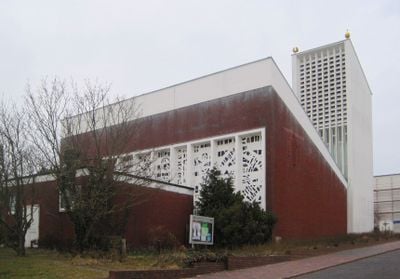
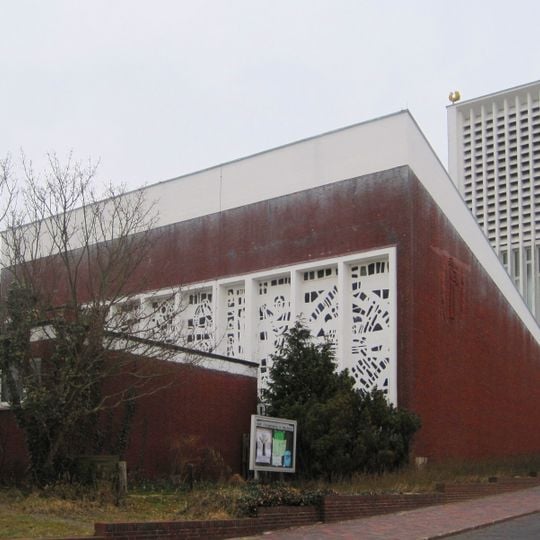
St. Willehad is a hall church of light concrete with red brick, built 1962–1964 on a nearly square plan. Its shed roof falls from south to north, against the rising ground, and a rectangular tower with a three-bell peal adjoins the northeast corner. Five tall white panels with cut-out patterns are set into the brick facade.
A first Catholic church, built for holidaymakers in 1901, already bore Willehad's name; it was destroyed by a bomb hit on 25 April 1945. The present church was built from 1962 to 1964 to plans by the Osnabrück architects Theo Burlage and Bernhard Niebuer. Kurt Weigel served as parish priest from 1994 to 2015, and Egbert Schlotmann has led the parish since 2015.
The church is named after Willehad, the missionary bishop on the lower Weser. Its predecessor, built for holidaymakers from 1901, already carried this patron; the present building kept the name after the old church was destroyed by bombs on 25 April 1945. Since 2015 Egbert Schlotmann has led the parish.
The church stands on Wangerooge, reached by ferry from Harlesiel; the island is car-free, so you continue on foot or by the island railway. The entrance is on the south side, where the tall glazed wall faces the street. The interior is white-plastered and level, with the altar island at the east end.
The church's three bells hang in a rectangular tower attached to the northeast corner, its sloped roof matching the pitch of the nave roof. The interior holds a baptismal font lid and a suspended cross made by metal sculptor Jakob Riffeler, and since 1997 an electronic organ with 36 stops.
The community of curious travelers
AroundUs brings together thousands of curated places, local tips, and hidden gems, enriched daily by 94,629 contributors worldwide.