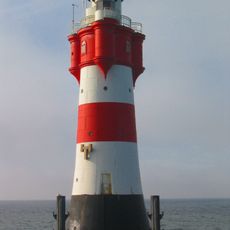
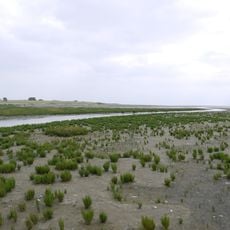
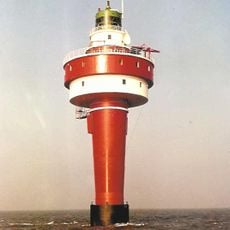
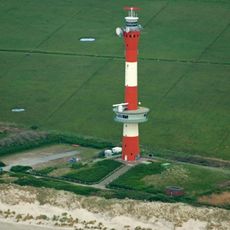
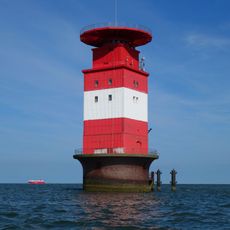
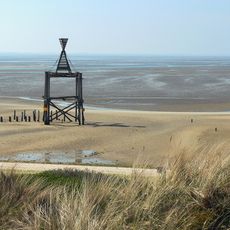
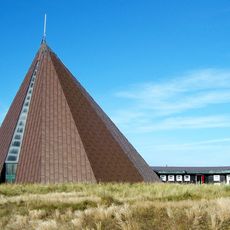
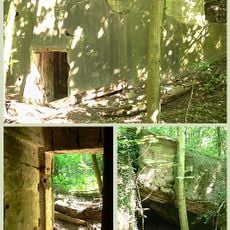
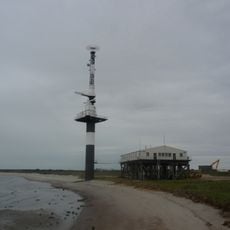
Key buoy, Safe water mark buoy in North Sea, Germany
The key buoy (Schlüsseltonne) is a floating lead mark north of the Roter Sand shoal off Wangerooge, guiding ships into the Weser. Since 1978 it has been painted red and white under the international system, and since 2008 it carries a solar-powered compact topmark lettered "ST". Its topmark has always been a key, the symbol of the Bremen coat of arms.
Bremen's Elterleute, the city's merchant representatives, laid out a new leading buoy north of Wangerooge on 20 April 1664, replacing one mentioned in 1642. It carried a key, the symbol of Bremen's coat of arms, as its topmark, hence the name. Renewed repeatedly, it was withdrawn in 1939 and only replaced on 1 September 1964; since 1978 it has been painted red and white.
The buoy's name comes from the gilded key, the symbol of Bremen's coat of arms, fixed as a topmark; a 1664 notice already called it the Schlüsseltonne or Bremer Tonne. Low German speakers know it as Slöteltunn. The key has been kept through every renewal, and since 2008 the solar topmark carries the letters "ST".
The buoy marks the start of the fairway to the Westerweser (Neuen Weser) north of the Roter Sand shoal, and its position has shifted only slightly over the centuries, following the natural movement of the sand. Since 2004 it has carried an LED light fed by a photovoltaic system, replaced in 2008 by a solar compact topmark lettered "ST". Approach it as the outermost mark of the Weser leading line, keeping to the charted channel.
Unlike most other buoy types, a safe water mark can be passed on either side, which gives it a different role from the buoys that must be left to port or starboard. This makes it one of the few marks at sea that does not prescribe a specific route.
The community of curious travelers
AroundUs brings together thousands of curated places, local tips, and hidden gems, enriched daily by 92,655 contributors worldwide.