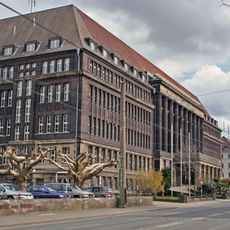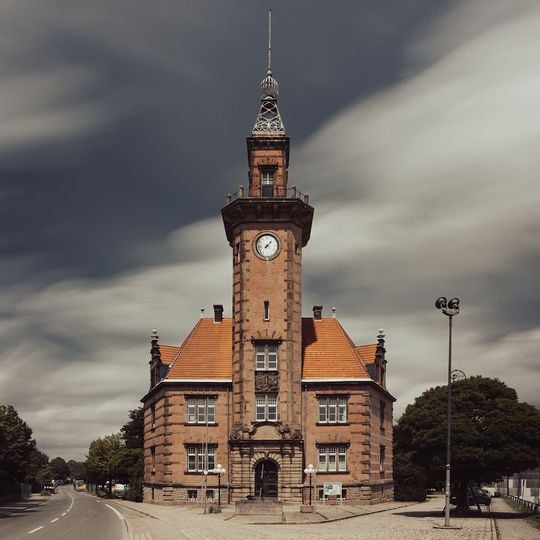
Altes Hafenamt Dortmund, Renaissance Revival office building in Dortmund, Germany.
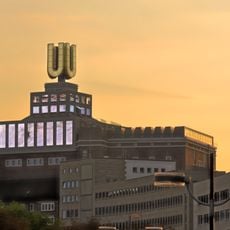
The Altes Hafenamt Dortmund is a Neorenaissance port administration building erected in 1898 to plans by city building inspector Friedrich Kullrich. Its 38-metre tower makes it visible from afar. The entrance portal is framed by three-quarter columns and ends in a carved Neptune head; above the cornice a granite plaque with a bronze relief of Wilhelm II recalls the Kaiser's visit on 11 August 1899.
The Altes Hafenamt Dortmund was built in 1898 to plans by the architect and city building inspector Friedrich Kullrich, in the Neo-Renaissance style, for the newly founded port of Dortmund. It served as the port administration until 1962. From 1982 to 1987 it was restored at considerable expense and is now one of the few public buildings in Dortmund from the Wilhelmine era.
The entrance hall displays a mosaic floor depicting a medieval Hanseatic trading ship with raised sails, representing Dortmund's connection to maritime commerce. This maritime imagery runs throughout the building and reminds visitors of the harbor's historical role in the city's development.
The Altes Hafenamt Dortmund stands at Sunderweg 130, its 38-metre tower visible from afar. The building is a listed monument and part of the Route der Industriekultur; today it houses offices of the Wasserschutzpolizei, so the interior is not open to visitors. The mosaic floor and the Kaiserzimmer survive in their original fittings and can only be seen on special occasions.
Two dolphin sculptures beneath the tower room balustrade support the coats of arms of Emden and Dortmund, a surprising connection between two German port cities. These sculptural details are often overlooked but reveal the networks and partnerships that shaped Dortmund's trading history.
The community of curious travelers
AroundUs brings together thousands of curated places, local tips, and hidden gems, enriched daily by 93,951 contributors worldwide.