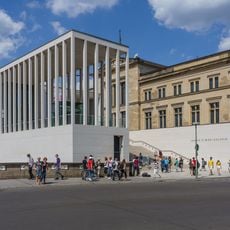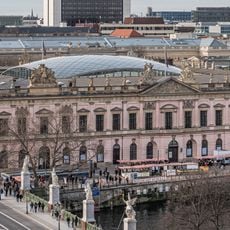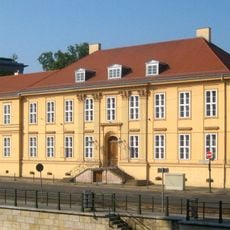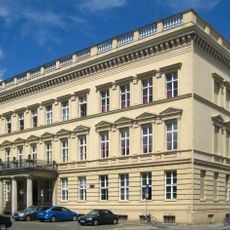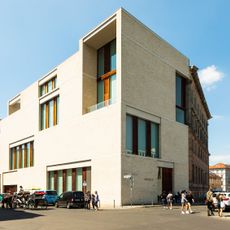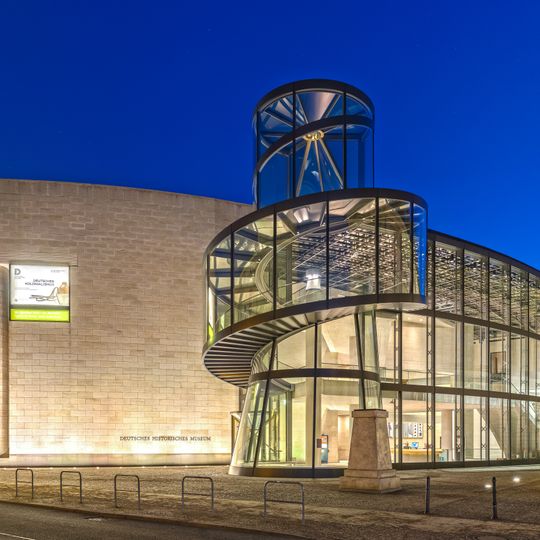
Exhibition Hall, German Historical Museum, Modern exhibition wing at German Historical Museum in Dorotheenstadt, Berlin, Germany
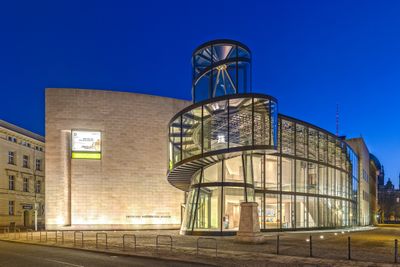
The Pei Building of the German Historical Museum is a modern addition on a footprint of just over 2,000 square metres, made of three linked parts: a triangular exhibition wing, a foyer with a curved glass facade, and rectangular workshop wings. The triangle recurs throughout, as in Pei's National Gallery East Wing and Bank of China Tower. The exhibition area offers about 2,600 square metres over four floors, reached from the Zeughaus through a glass-domed courtyard and an escalator down to the lower level.
The building was designed by I. M. Pei, born 1917 in China and living in New York, who accepted the Berlin commission after a direct approach following talks with the chancellor. The first sod was turned in August 1998, the shell was celebrated in April 2002, and the keys were handed over on 23 May 2003; the cost was 47 million euros. It replaced 1950s depot and workshop buildings demolished on the same spot.
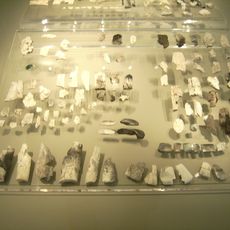
The space hosts rotating exhibitions that explore German history, social movements, and artistic expressions from different periods. Visitors encounter themes that connect past events with contemporary questions and concerns.
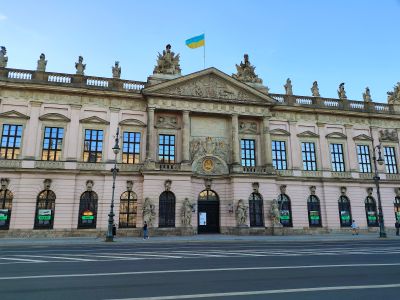
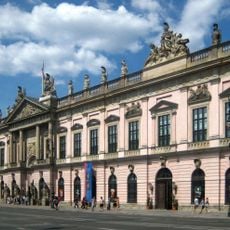
The hall is located at Unter den Linden 2 and open daily from 10 AM to 6 PM, with several S-Bahn and U-Bahn stations within easy reach. The entrance connects directly to the baroque main building, offering visitors straightforward access to both structures.
The triangular shape of the exhibition wing recurs throughout the building, echoing two earlier Pei works: the East Wing of the National Gallery in Washington and the Bank of China Tower in Hong Kong. The plan combines a triangle for the galleries, a circular arc for the foyer facade and a rectangle for the workshop wings.
The community of curious travelers
AroundUs brings together thousands of curated places, local tips, and hidden gems, enriched daily by 93,099 contributors worldwide.