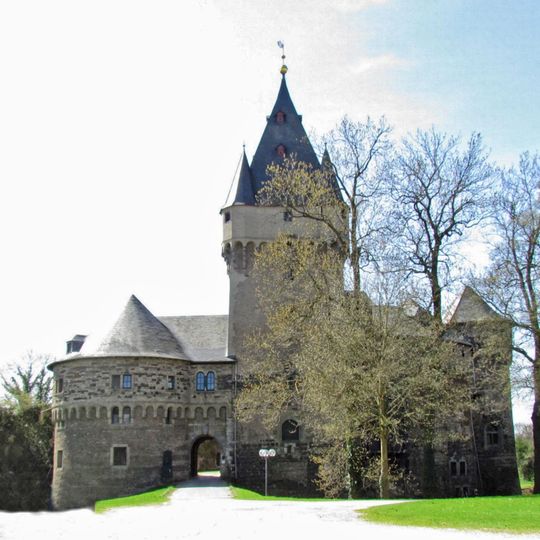
Schloss Hülchrath, Former Electoral-Cologne moated castle in Hülchrath, Grevenbroich, Germany
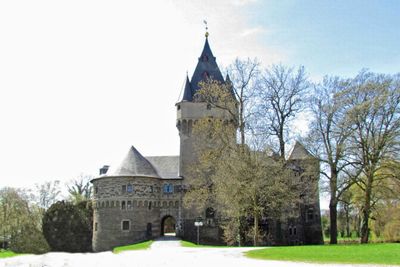
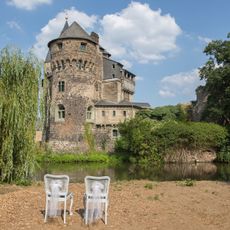
Schloss Hülchrath is a former Electoral-Cologne state castle on the Gillbach in the Hülchrath district of Grevenbroich. Rough grey masonry forms a square central tower with a steep slate roof and spire, a lower hip-roofed wing to its right, and a round corner turret with a conical roof and arched openings above a gateway on the left. A dark round-arched portal sits below the tower.
The castle was built in medieval times as a fortified residence and suffered major destruction in 1583 from military conflict. Reconstruction afterward fundamentally altered the original layout and shaped the buildings' current appearance.
The name Hülchrath goes back to the 1120 form Holkerode, and the settlement beside the castle was already called an oppidum in 1321. The private complex has served as a film set, for the fairy-tale film The Water of Life (2017) and the Tatort episode Es lebe der König! (2020).
The grounds are private property and only accessible with the owner's permission; an interior tour is not possible. The complex lies on the Gillbach in the Hülchrath district of Grevenbroich, and the castle and village together form a protected monument area. Views of the masonry, the square tower and the round corner turret are possible from outside the grounds.
In 1583, during the Truchsessian War, Gebhard Truchsess von Waldburg and his wife Agnes von Mansfeld-Eisleben fled behind the castle walls; after a thirteen-day cannonade the garrison surrendered on 16 March 1583, and the couple are said to have escaped beforehand through a secret passage.
The community of curious travelers
AroundUs brings together thousands of curated places, local tips, and hidden gems, enriched daily by 92,863 contributors worldwide.