Friedensplatz, Public park in central Oberhausen, Germany.
Friedensplatz is a public park in central Oberhausen featuring a linear layout with water basins, planted beds and rows of trees. The space is shaped by these elements that structure and define how visitors move through it.
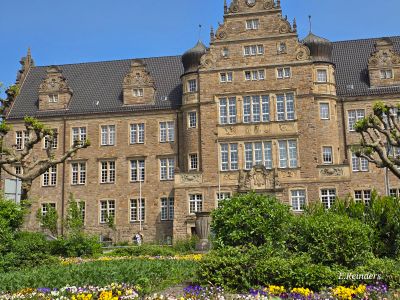
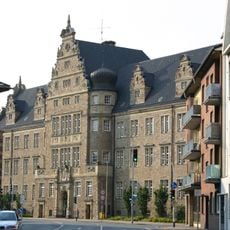
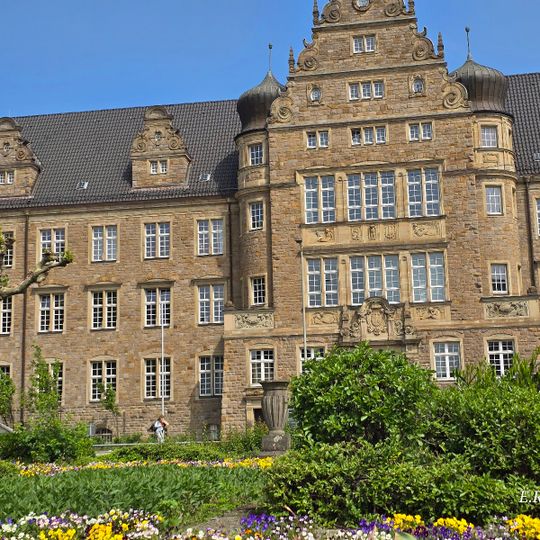
From 1854 to 1902 the site held the Styrumer Eisenindustrie AG works, which went bankrupt in 1901. After demolition the city refused new industry and planned a station forecourt, but the railway declined; instead the 1907 Neo-Renaissance District Court rose on the north edge. The square, first Kaiserplatz, became Industrieplatz in the Weimar Republic, was renamed Adolf-Hitler-Platz under the Nazis, and has been Friedensplatz since 1945.
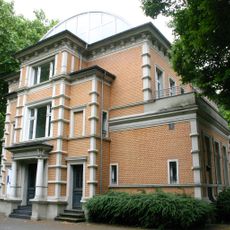
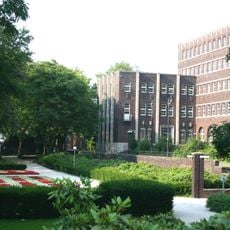
The long sides of the square are lined with public buildings from 1924 to 1927, designed by Eduard Jüngerich and Ludwig Freitag in the style of Brick Expressionism: the police headquarters, a branch of the Reichsbank (later the Landeszentralbank) and the municipal finance and cadastral office. The name changed several times: Kaiserplatz, then Industrieplatz in the Weimar Republic, Adolf-Hitler-Platz during the Third Reich, and Friedensplatz since 1945.
The square has been closed to motor traffic since the 1980s, so visitors cross it on foot. Its central axis of elongated water basins, flower beds and double rows of plane trees gives a clear orientation from north to south, ending at the fountain.
A District Court building from 1907 stands at the northern edge of the plaza with Neo-Renaissance design details. This structure displays a different architectural approach than surrounding buildings and adds historical depth to the space.
The community of curious travelers
AroundUs brings together thousands of curated places, local tips, and hidden gems, enriched daily by 94,998 contributors worldwide.