Heidenloch, Medieval mine shaft on Heiligenberg, Heidelberg, Germany.
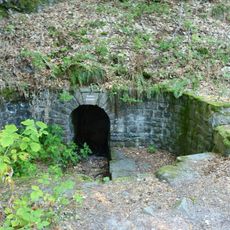
The Heidenloch is a 55-metre-deep shaft, 3 to 4 metres across, on the Heiligenberg above Heidelberg, a few metres west of the viewing tower on the Heiligenberg road. Its head was long covered by a masonry vault with a small grated opening; in 1936 the vault was removed and the shaft excavated, and since 1987 a protective hut stands over the open shaft.
In 1936, workers from the Palatinate Museum explored the shaft and brought up metal objects including keys, horseshoes, and stirrups. These finds point to a long period of use, though the exact origin and first purpose of the shaft remain unclear.
The name Heidenloch ("heathen hole") reflects the old belief that the shaft was pre-Christian work. In 1548 Sebastian Münster described "wonderfully old heathen-walled holes" on the Heiligenberg, and Matthäus Merian made the first accurate engraving in the early 17th century. Later writers spun legends of a secret passage to the Neckar and of Satan dwelling inside.
A cover structure built in 1987 protects the shaft opening and allows visitors to look down safely. The Heiligenberg is reached on foot through wooded paths, so sturdy footwear is a good idea, and the air near the shaft tends to be noticeably cooler.
The shaft's fill included objects from the nearby monasteries, and a well casing was lifted from the bottom at a depth of 52 metres during the 1936–1938 excavations. Work stopped in 1938; the stones were put back and the opening covered with thick wooden beams.
The community of curious travelers
AroundUs brings together thousands of curated places, local tips, and hidden gems, enriched daily by 92,854 contributors worldwide.