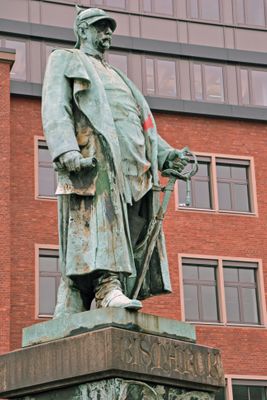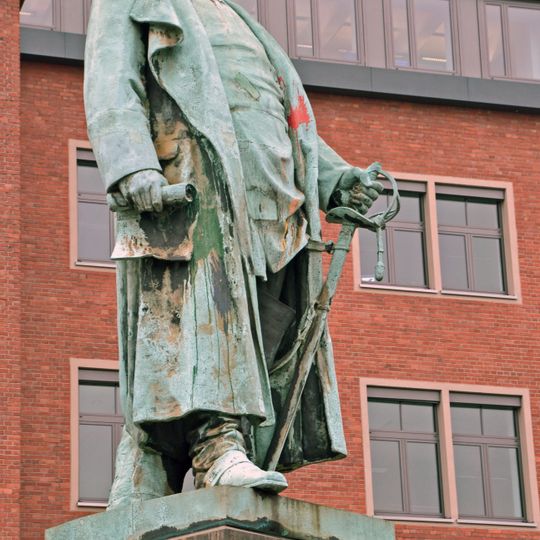
Bismarck-Denkmal, Bronze monument at Bismarckplatz, Essen, Germany.
The Bismarck Monument on the south side of Bismarckplatz consists of a 1.2-metre Kösseine granite base topped by a two-metre bronze statue of Chancellor Otto von Bismarck in military coat, sabre and Pickelhaube, giving a total height of 3.2 metres. Bronze reliefs on the four sides of the base are framed by oak trunks whose branches link the scenes.
The Bismarck Committee decided on 2 February 1899 to place the statue on Bismarckplatz, named around 1887, and it was unveiled there on 23 September 1899. The sculpture by Reinhold Felderhoff was largely financed by industrialist Alfred Krupp, whose steelworks Bismarck was seen to protect; in 1879 Bismarck became Essen's first honorary citizen. It stood before the main entrance of the Royal Railway Directorate.
The four bronze reliefs on the granite base are framed by oak trunks whose branches link the scenes. The northern panel shows a Bavarian and a Prussian soldier shaking hands beneath oaks, sealing German unity after the victory over France. The southern relief depicts Germania sheltering Krupp smiths who forged weapons for the wars of 1864, 1866 and 1870/71.
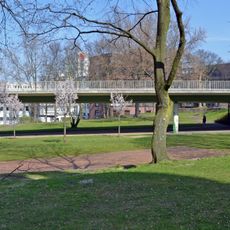
The monument stands in the public Bismarckplatz and is easily accessible on foot. Recent restoration work in 2022 included structural examination and repairs to ensure its long-term preservation.
The monument survived the Second World War with only a few bullet holes. During construction of the Ruhrschnellweg tunnel and the U-Bahn, it was dismantled and stored from 1 February 1968 to 19 October 1970.
The community of curious travelers
AroundUs brings together thousands of curated places, local tips, and hidden gems, enriched daily by 93,399 contributors worldwide.