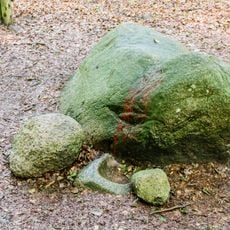
Opferstein von Quoltitz, Glacial erratic boulder in Quoltitz, Rügen, Germany
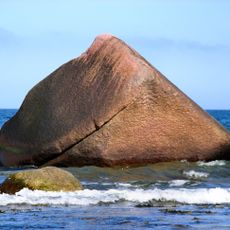
The Quoltitz sacrificial stone is a granite boulder located at the edge of Jasmund National Park north of Neddesitz village. This rock rises prominently from the ground with a pink-toned surface and displays numerous small depressions across its face.
Karl Nernst first described the stone in 1797 in his "Wanderungen durch Rügen". Caspar David Friedrich drew it on 17 July 1806, and in 1816 he painted "Opferstein bei Quoltitz im Morgenrot", now lost, based on that drawing. Johann Jacob Grümbke covered it in 1805 and 1819.
Locals call the cup-shaped hollows on the stone "Blutgrapen" (blood pots); they measure 5 to 6 cm across and are of very early origin, interpreted as ritual marks whose purpose archaeology has not settled. A 12 cm wide and deep groove runs over the north-western end, read by some as an attempt to split the stone and by others as ritual.
The stone sits in a rural setting at the edge of the national park and is accessible on foot. Visitors should wear sturdy shoes as the ground is uneven and weather conditions can change quickly.
The stone's name may derive from the old Norse "kval", meaning torment or violent death, fitting the nearby field once called "Bloodbek" (blood stream). Archaeologists found human bone remains, a large flint dagger and amber beads here, reviving debate about bloody sacrifices.
The community of curious travelers
AroundUs brings together thousands of curated places, local tips, and hidden gems, enriched daily by 93,008 contributors worldwide.