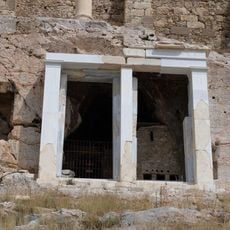
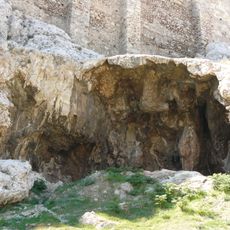
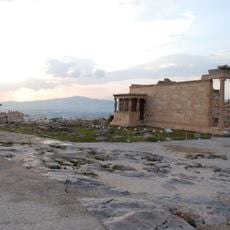
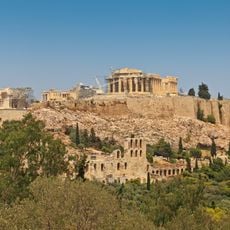
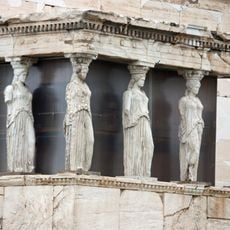
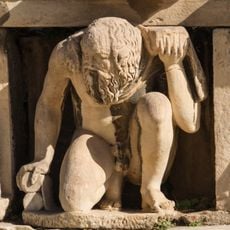
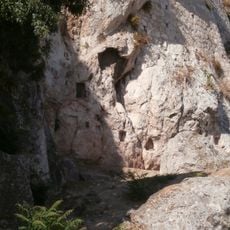
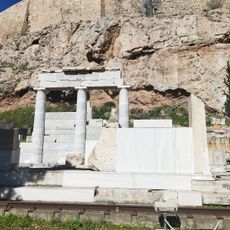
Sanctuary of Pandion, Greek sanctuary in Acropolis, Athens, Greece.
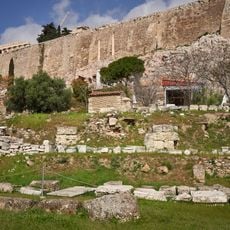
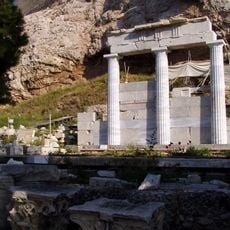
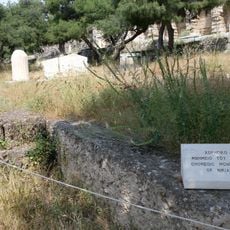
Sanctuary of Pandion is a rectangular open-air structure on the Acropolis, divided by an internal wall into two equal zones. The space was accessed through a columned portico on its western facade.
The building identified as the sanctuary was erected in the late fifth century BCE on ground levelled for the Acropolis circuit wall, replacing an earlier classical structure torn down for it. Its foundations came to light in excavations begun in 1885 by Panagiotis Kavvadias with Georg Kawerau, who built a small museum on the spot between 1887 and 1888. Sculptures including the Moschophoros were found in the Perserschutt beneath it.
Pandion was the eponymous hero of the Attic tribe Pandionis, and according to tradition the tribe gathered here to celebrate the Pandia, a festival for Zeus held in the month Elaphebolion, around mid-March to mid-April, alongside the Great Dionysia. The festival's importance faded over time, which may have led to the site's abandonment.
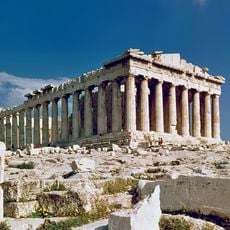
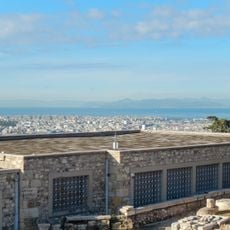
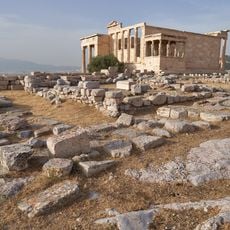
The foundations of Building IV lie in the south-east corner of the Acropolis, about 25 m east of the Parthenon, on the spot later occupied by the old Acropolis Museum built by Georg Kawerau between 1887 and 1888. The area is open to the sky, with no shade or shelter, and is reached on foot over the uneven rock of the archaeological site.
The identification with Pandion rests on a proposal by Gorham P. Stevens in 1946, not on direct evidence. Noel Robertson instead placed the sanctuary near that of Zeus Polieus and argued that Building IV belonged to Erechtheus. The building's foundations also yielded sculpture from the Persian destruction rubble of 480 BCE, among it the Moschophoros.
The community of curious travelers
AroundUs brings together thousands of curated places, local tips, and hidden gems, enriched daily by 94,060 contributors worldwide.