Montmartre Cemetery, Historical cemetery in 18th arrondissement of Paris, France
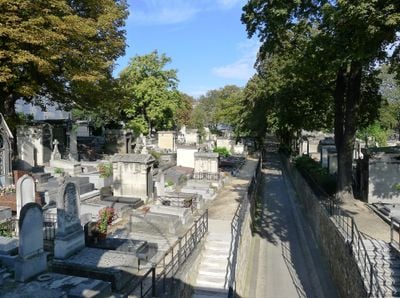
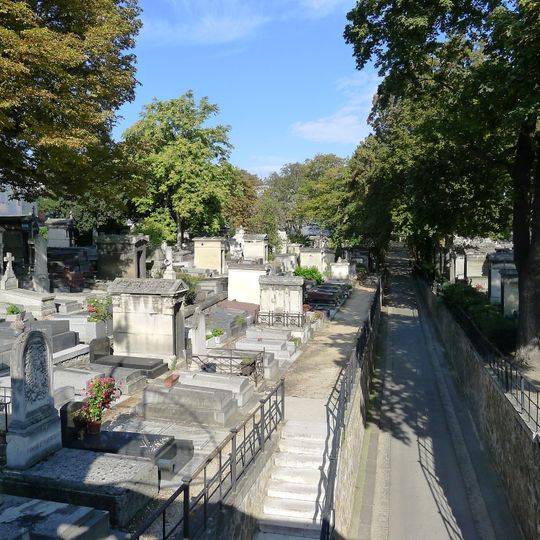
Montmartre Cemetery lies below street level in a former gypsum quarry in the 18th arrondissement of Paris and spans several hectares. The graves sit among hundreds of old trees and beneath a metal bridge that carries a street overhead.
The burial ground opened on January 1, 1825, as part of a plan to create cemeteries outside Paris city limits. The municipal authorities decided on this measure after burial grounds inside the walls became overcrowded during the 1780s.
The grave of singer Dalida, topped by a life-size sculpture and golden rays, is the most visited and most flowered in the cemetery. The cemetery also holds the tombs of painter Edgar Degas and filmmaker François Truffaut, and it appears in Guy de Maupassant's 1891 short story "Les Tombales" and in Truffaut's 1959 film "Les Quatre Cents Coups".
Free maps are available at the entrance on Avenue Rachel, and the site sits below street level under Rue Caulaincourt. The paths between the tombstones are mostly level, though some sections have uneven paving.
The cemetery occupies a former gypsum quarry, not a limestone one; its plaster was used widely across Paris. The Caulaincourt Bridge, a metal structure inaugurated on 16 December 1888 by prefect Eugène Poubelle, passes directly over the graves. Dalida's tomb, with a life-size sculpture and golden rays, is the most visited and most flowered in the cemetery.
The community of curious travelers
AroundUs brings together thousands of curated places, local tips, and hidden gems, enriched daily by 93,357 contributors worldwide.