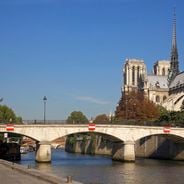
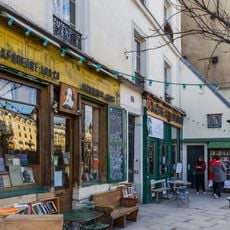
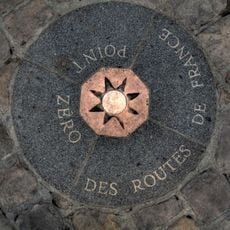
Square René-Viviani, Urban park near Notre-Dame Cathedral in Latin Quarter, France.
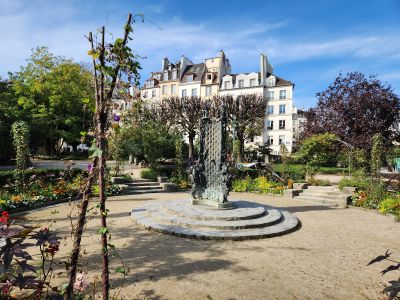
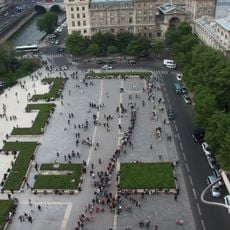
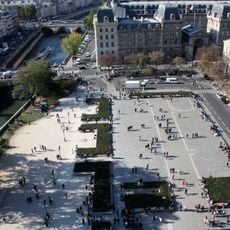
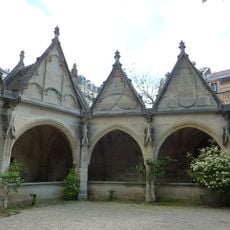
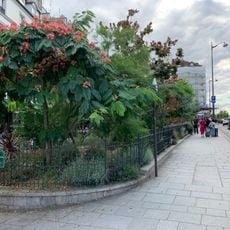
Square René-Viviani is an irregular public garden of 4,265 m² between the Quai de Montebello and the Church of Saint-Julien-le-Pauvre. Pale gravel paths bordered by low hedges and rows of clipped trees surround an oval bed holding a dark stone monument on a circular base. Green metal chairs and benches sit on the gravel.
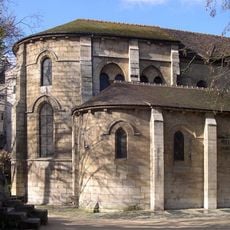
The site held a cemetery beside a 6th-century basilica, the original Church of Saint-Julien, where Merovingian graves were excavated in the 19th century. A Cluniac priory later occupied the plot, followed by an annex of the Hôtel-Dieu. After that annex was cleared, the square was laid out in 1928 and named for René Viviani, France's first Minister of Labour.
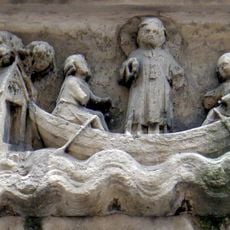
The bronze fountain by Georges Jeanclos, installed in 1996, depicts the legend of Saint Julien the Hospitaller: a curse by witches, a talking deer, mistaken identity and a supernatural intervention. Medieval hospitals, inns and ferrymen adopted Julien as patron, and pilgrims on the road to Santiago prayed to him for lodging.
The square has three entrances: at 2 rue du Fouarre, at 25 quai de Montebello at the corner with rue Saint-Julien-le-Pauvre, and a third along that same street. It is served by RER B and C at Saint-Michel - Notre-Dame and by metro line 4 at Saint-Michel and line 10 at Cluny-La Sorbonne. Some areas are accessible to people with reduced mobility, there is a drinking water point, and dogs must be kept on a leash in the paths.
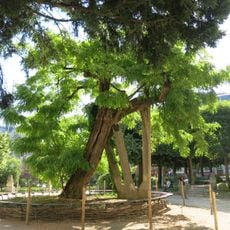
The black locust (Robinia pseudoacacia) here was planted in 1601 by botanist Jean Robin from a seed brought from the Appalachian Mountains; it stands 11 m tall with a 3.85 m circumference and is held up by two concrete crutches. It lost its upper branches to a shell in World War I but still blooms each year.
The community of curious travelers
AroundUs brings together thousands of curated places, local tips, and hidden gems, enriched daily by 94,521 contributors worldwide.