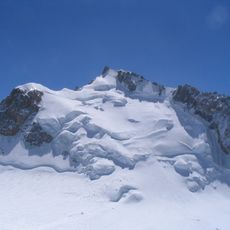
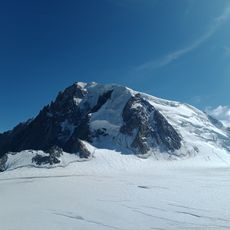
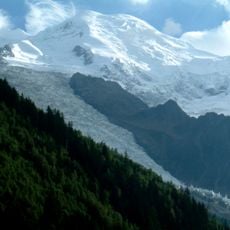
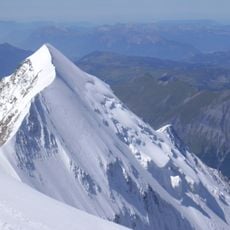
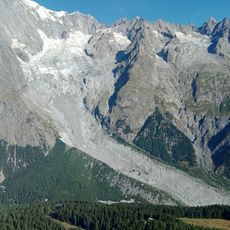
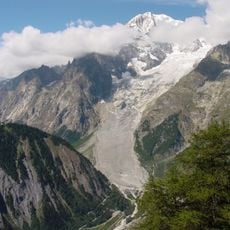
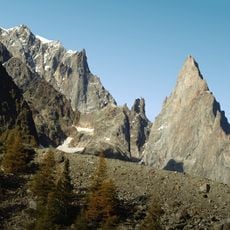
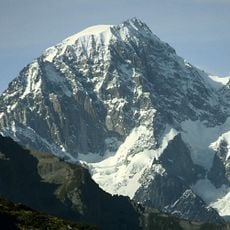
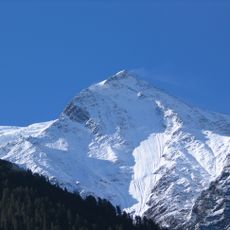
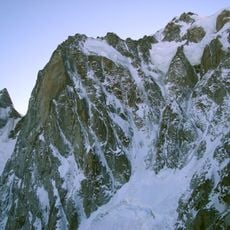
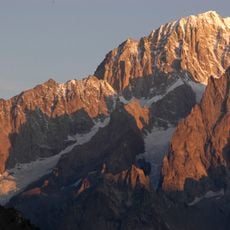
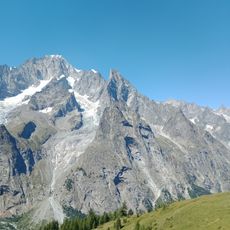
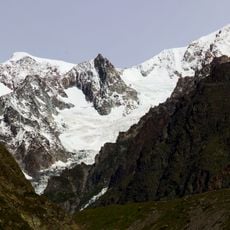
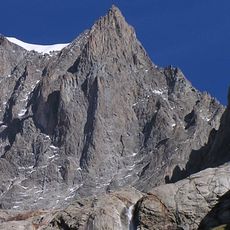
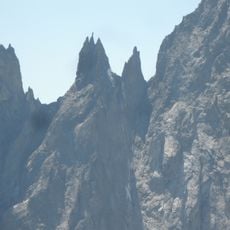
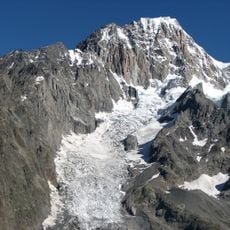
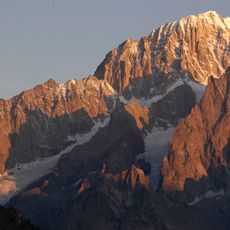
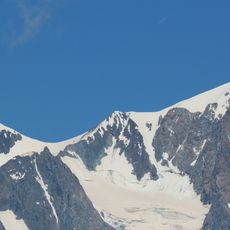
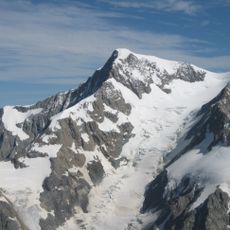
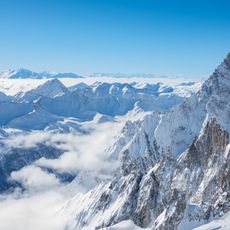
Rocher de la Tournette, Secondary summit of Mont Blanc in Chamonix-Mont-Blanc, France.
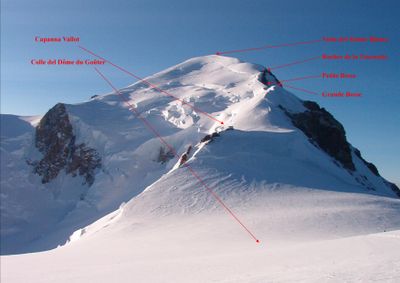
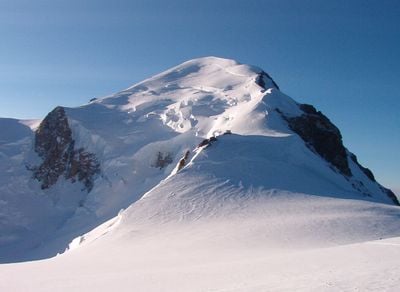
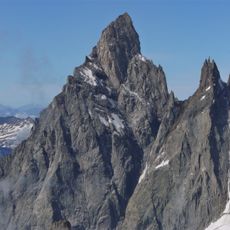
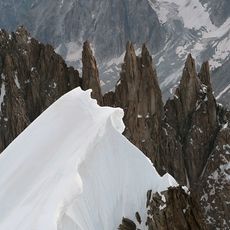
Rocher de la Tournette is a rocky point on the icy summit ridge of Mont Blanc, between the Petite Bosse and the summit, on the Franco-Italian border. Its highest point lies at 4,677 metres, and it is most easily reached on an ascent of Mont Blanc via the Goûter Route. The photograph shows a snow-covered rounded peak with exposed dark rock, a steep shadowed snow face descending left, and a dark rocky step jutting through the snow near the top right.
The rock spur was first climbed on July 2, 1872, by T. Kennedy, J. Carrel, and J. Fischer, who approached from the Italian side. This ascent was one of the early explorations of the Mont Blanc massif beyond the main summit route.
The rock's name, Tournette, refers to a winding shape, echoed in the Tournette Spur (l'éperon de la Tournette), the AD-graded route from the Quintino Sella Hut that joins the Bosses Ridge. Climbers on the Goûter Route pass the outcrop between the Petite Bosse and the summit without noticing it. The 1950 and 1966 Air India crashes near the rock inspired Henri Troyat's 1952 novel La Neige en deuil and Marc Levy's 2013 Un sentiment plus fort que la peur.
The Rocher de la Tournette is reached via the Gouter Route, which requires solid alpine experience, proper gear, and physical preparation before setting out. Conditions at this altitude can shift without warning, so an early start and flexibility in plans are strongly advised.
The rock is the highest point on the UIAA's enlarged list of lesser summits, at 4,677 m. Two Air India crashes struck it: the Malabar Princess on 3 November 1950, killing 48, and a Boeing 707 on 24 January 1966, killing 117. A rumour of gold bars never found persists; 136 grams of diamonds were recovered in 2013.
The community of curious travelers
AroundUs brings together thousands of curated places, local tips, and hidden gems, enriched daily by 93,660 contributors worldwide.