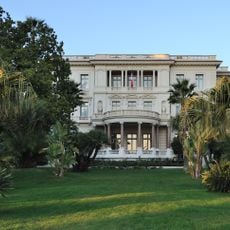
Abbaye de Roseland, Historical monument in Nice, France.
Abbaye de Roseland is a fantasy abbey created around 1925 from a 17th-century country house. Its cloister has 26 columns from the 5th and 6th centuries, taken from the monastery of La Daurade in Toulouse, plus elements from Bonnefont Abbey. The orange building with a tiled roof and central tower stands in a botanical park.
The estate began as a country house of the Dalmassi family; Jean-Ange Dalmassi de Farone bequeathed it in 1763 to his cousin Alexandre Auguste de Lascaris de Vintimille. Seized during the Revolution, it was bought in 1815 by the Jaume family, who produced oil and wine, and sold in 1878 to a Russian count, Apraxine. Around 1925 antiques collector Édouard Larcade rebuilt it as a folly, incorporating 26 columns of the 5th–6th centuries from the Daurade monastery in Toulouse and elements from Bonnefont Abbey.
The name Roseland comes from the rose garden that landscape architect Octave Godard planted between 1923 and 1927, which Édouard Larcade then adopted for the property. The garden was laid out in Italian style. The building itself is a fantasy abbey, assembled by Larcade from medieval fragments rather than built as a monastery.
The historic building stands at 44 boulevard Napoléon III, inside a residential complex of more than 600 flats, so access to the house and gardens is not open to the public. The city of Nice received the house and part of the gardens in 1970; in 2023, with major works needed, it considered selling the property.
From 13 July to 13 September 1961, Jean Larcade, Édouard's son and owner of an avant-garde Paris gallery, held the first Festival of New Realism here, with Arman and Yves Klein among the participants. The event took place in the fantasy abbey his father had assembled from medieval fragments.
The community of curious travelers
AroundUs brings together thousands of curated places, local tips, and hidden gems, enriched daily by 94,326 contributors worldwide.