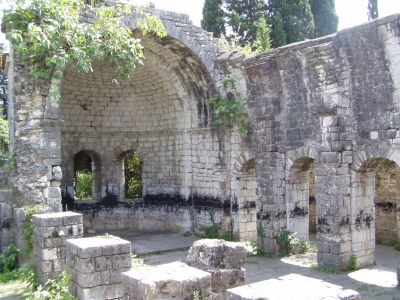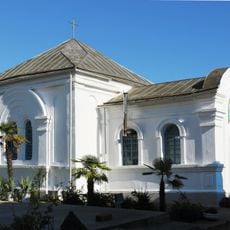
Gantiadi church, 6th-century Christian church in Gagra district, Georgia.
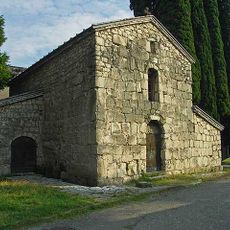
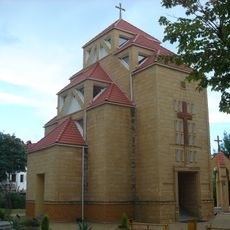
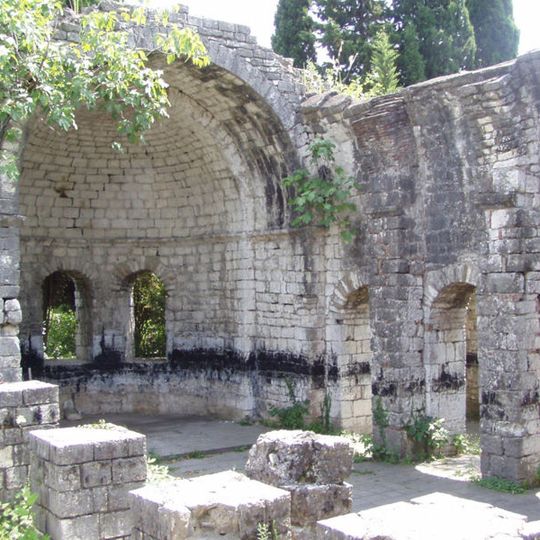
Gantiadi church is a three-nave basilica built in the 6th century using limestone blocks and bricks of varying sizes. The structure shows typical early Christian construction methods from this era with visible stone joints and thick walls.
Built in 543 under Justinian I, the basilica is linked by scholar V. Lekvinadze to the church for the Abazgs that Procopius of Caesarea attributes to the emperor. It was altered in the 8th–10th centuries and partly destroyed by Ottoman invaders in 1576. Excavations in 1980 under L. Khrushkova revealed a baptistery, tombs and fragments of marble decoration and Greek inscriptions.
The church is also called Tsandripshi Church, after the settlement's older name; the Abkhaz form is Gantiaadi iqou anykhabaa. A fragment of a 6th-century tombstone with a Greek uncial inscription was found in the ruins, likely marking the grave of a clerical or secular dignitary whose name is lost.
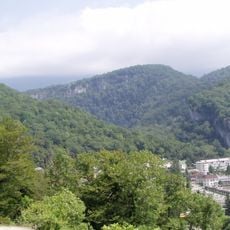
The site is reachable through the road network of Gagra district and sits in an open landscape. Visitors should wear sturdy footwear since the ruins sit on uneven ground and access paths are rustic.
Archaeologists discovered a tombstone with Greek inscriptions at this location, offering insights into the burial practices of early inhabitants. The find shows that a mixed population with different cultural backgrounds lived and worshipped here.
The community of curious travelers
AroundUs brings together thousands of curated places, local tips, and hidden gems, enriched daily by 94,434 contributors worldwide.