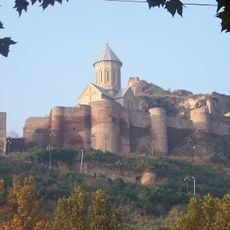
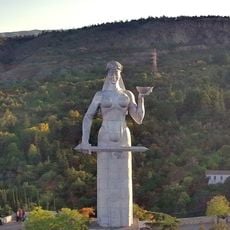
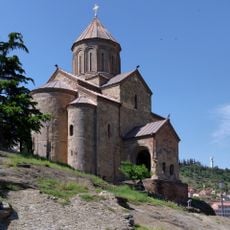
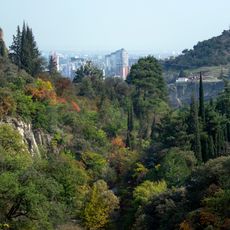
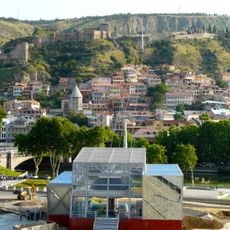
Tabori church, Orthodox church on hill near Abanotubani district, Tbilisi, Georgia.
Tabori Church stands on the north-western tip of the Tabori ridge above the Botanical Garden in Tbilisi. The present church was built between 1995 and 2001; the medieval fortress of Tabori, also called Korchi-Kala, survives only as foundation ruins. Excavations in 1972 uncovered remains of a wall built of cut stone and fragments of medieval clay vessels.
Tabori Fortress, also called Korchi-Kala, guarded the Ganja road into Tbilisi. It is first mentioned in the chronicle Matiane Kartlisa for 1045, when King Bagrat IV took the city and its fortresses. The Persians destroyed it in 1735 and 1743; King Erekle II stormed it in 1748. It was finally ruined during Agha Mohammad Khan's invasion in 1795. The present church was built in 1995–2001.
The hill's name comes from Mount Tabor, which Christian tradition holds as the site of the Transfiguration. The church standing inside the fortress grounds was built between 1995 and 2001; the medieval church that once stood there has not survived. The Turkish name Korchi-Kala, recorded in a 1776 charter, means "guard fortress".
The fortress site sits on the north-western tip of the Tabori ridge, directly above the Botanical Garden, and only foundation ruins remain. The present church there was built between 1995 and 2001, so the walk leads to a modern building on a medieval fortified site. The old road from the south, the Ganja road, passed below the ridge.
The fortress on this ridge was called Korchi-Kala, Turkic for "guard fortress", because it watched the Ganja road entering Tbilisi from the south. A 1800 city plan by Captain Chuyko still labels it the "plundered fortress Korchi-Kala".
The community of curious travelers
AroundUs brings together thousands of curated places, local tips, and hidden gems, enriched daily by 93,162 contributors worldwide.