Narikala, 4th-century fort in Tbilisi, Georgia
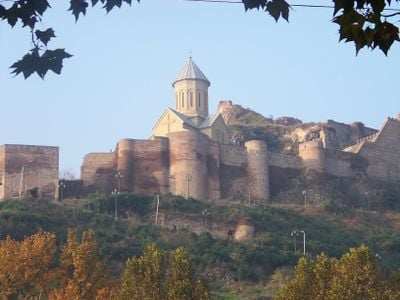
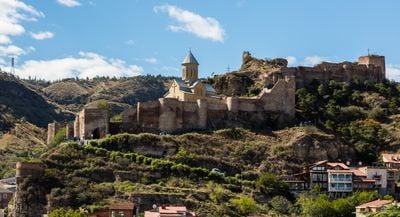
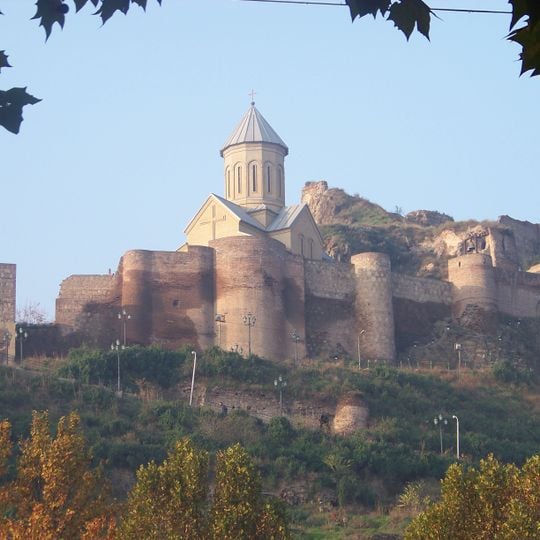
Narikala is a 4th-century fortress on a steep hill in Tbilisi, Georgia, located between the sulfur baths and the botanical gardens of the capital. The compound consists of two walled sections with towers, battlements, and remains of defensive structures.
A fortress stood here by the second half of the 4th century, built under King Varaz-Bakur and called Shuris-Tsikhe; it passed to the Persians at the end of that century and was retaken by the kings of Kartli by the mid-5th century. The Umayyads expanded it in the 7th century and David the Builder enlarged it further. The Mongols named it Narin Qala, "Little Fortress"; most surviving walls date from the 16th and 17th centuries, and an 1827 earthquake damaged parts that were then demolished.
Saint Nicholas Church within the compound shows wall paintings with scenes from Georgian history and biblical stories. Visitors can see the connection between religious tradition and national identity in the images.
Visitors reach the compound through a walking path from Meidan or by cable car from Rike Park. The footpath leads uphill through narrow lanes, while the ride takes about two minutes to the upper section.
The Mongols called the fortress "Narin Qala", meaning "Little Fortress", and this name replaced the older Georgian name Shuris-Tsikhe, "fortress-rival". The lower court's St Nicholas Church, rebuilt in 1996–1997, stands on the site of a 12th-century church whose ruins were found during excavations in 1967.
The community of curious travelers
AroundUs brings together thousands of curated places, local tips, and hidden gems, enriched daily by 93,640 contributors worldwide.