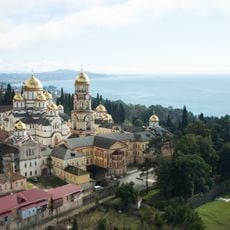
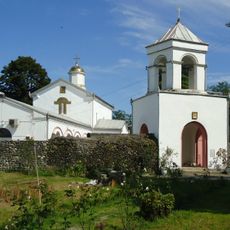
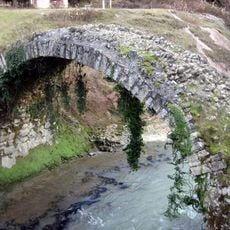
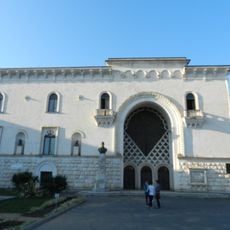
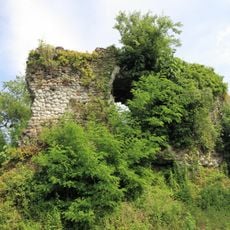
Dranda Cathedral, Eastern Orthodox cathedral in Dranda, Georgia.
Dranda Cathedral is an Eastern Orthodox cathedral in Dranda village, in the Abkhazia region of Georgia. The building has a rectangular plan with a central dome resting on four pillars and thick stone walls on the exterior.
The cathedral was built in the 6th century under the Byzantine Emperor Justinian I, when the region was under Byzantine influence. In the medieval period it became a bishop's seat of the Georgian Orthodox Church.
The cathedral was long the seat of the bishops of Dranda, and the monastery founded there in 1881 was closed in 1928. The frescoes seen by Dmitry Bakradze in 1860, including a Christ and several full-length saints, later collapsed and were not restored. Since 2011 the building has been used by the Abkhaz Orthodox Church.
Dranda village is located south of Sukhumi and can be reached by local transport. Wear sturdy shoes when visiting the grounds around the cathedral, as the terrain can be uneven.
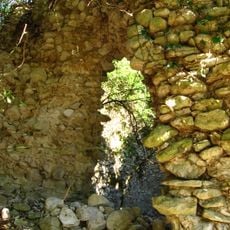
A tunnel about 260–280 m long starts near the cathedral's western wall and descends to the Kodori River. In the late 19th century a marble slab with a relief of the Savior was found inside it, and another slab showing the Savior and the Mother of God was also recovered; P. Uvarova published photographs of them.
The community of curious travelers
AroundUs brings together thousands of curated places, local tips, and hidden gems, enriched daily by 93,196 contributors worldwide.