Planetarium Budapest, Space education center in Budapest, Hungary
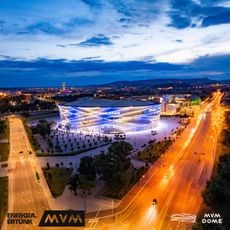
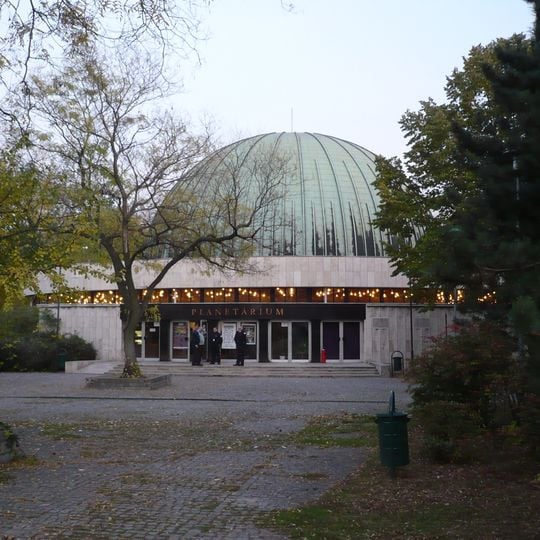
Planetarium Budapest is a closed planetarium in Népliget, Budapest, whose building was handed over on 17 August 1977. Its exactly hemispherical dome measures 23 metres in diameter, and the building covers almost 1,000 square metres. The auditorium held 400 people, while the entrance and exhibition hall could take 500. It has been shut since 18 June 2017 pending a full renovation.
Antal Tass, director of the Svábhegy Observatory, first proposed a Hungarian planetarium in the 1920s. György Kulin arranged the purchase of a Zeiss UNIVERSAL-II projector, which arrived in 1944 but disappeared during the war. A Zeiss ZKP-1 shown at the Budapest International Fair from 1961 led to a UNIVERSAL-VI ordered in 1966 and delivered in 1969. Built to plans by László Lux and Tamás Tömöry, the building opened on 17 August 1977, with the first show on 20 August.
The building housed the LézerSzínház from 1980 to 2010, whose first light show, Lézerofónia, opened in April 1980; over 25 years 47 light plays drew nearly 700,000 spectators. Its laser concerts set to music by Mike Oldfield (1983), Led Zeppelin and Genesis (1987), Depeche Mode (1989), U2 (1990) and Madonna (1999) are part of local memory. The institution has been closed since 18 June 2017.
The building has been closed since 18 June 2017, and as of early 2024 no reopening date had been set; renovation was once planned for 2019. It stands in Népliget park, and the 23-metre dome is visible from outside. After the 2016 flood damage, show capacity was cut from 350 to 150 before the closure.
The building has been closed since 18 June 2017, after repeated roof leaks; a full renovation was estimated at 2.6 billion forints, and by early 2024 no reopening date had been set. The dome, 23 m across, was designed by László Lux and Tamás Tömöry.
The community of curious travelers
AroundUs brings together thousands of curated places, local tips, and hidden gems, enriched daily by 92,770 contributors worldwide.