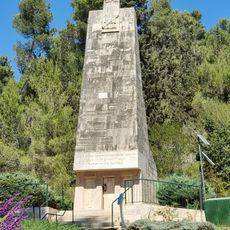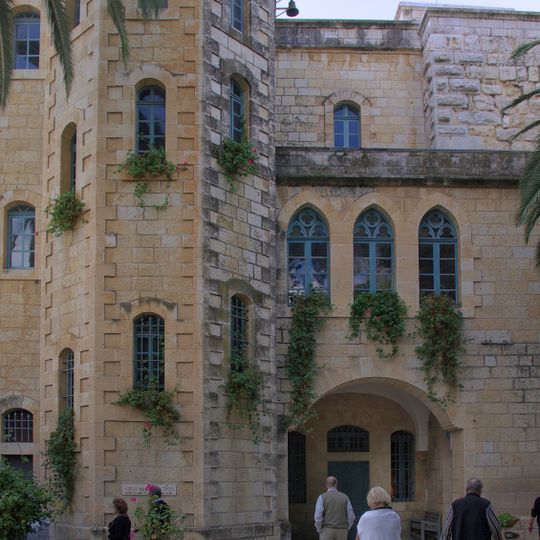
Benedictine monastery in Abu Ghosh, Benedictine monastery in Abu Ghosh, Israel
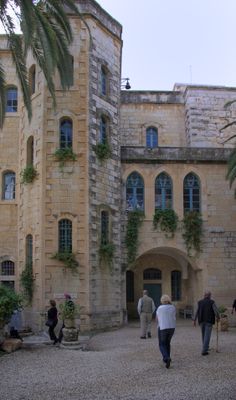
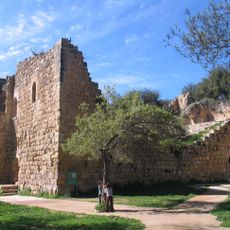
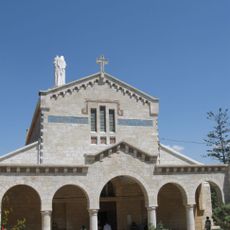
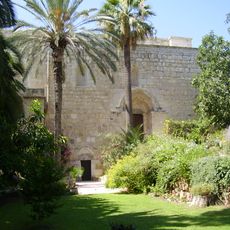
The Benedictine monastery in Abu Ghosh, officially St Mary of the Resurrection Abbey, is a monastery in the center of Abu Ghosh, Israel. Its abbey church, built by the Hospitallers in 1140 in a late Romanesque/early Gothic style, has three equal naves, each ending in an apse, and a two-level crypt around a spring. The walls bear Crusader-period frescoes painted in Byzantine style between 1150 and 1175, restored between 1995 and 2001.
Crusaders of the Order of Saint John built the Church of the Resurrection in 1143 on the foundations of a Roman reservoir, identifying Abu Ghosh with biblical Emmaus. Abandoned after 1187, it served the villagers as a stable or barn. The Ottoman Empire entrusted the site to France in 1873; Benedictine monks from the abbey of Belloc founded the monastery in 1900, Lazarists took over in 1953, and monks from Bec-Hellouin restored monastic life in 1976. It became an autonomous abbey in 1999.
The community is a double monastery of monks and nuns who pray the divine office together while living in two separate houses. It was founded in 1900 and canonically erected as an autonomous abbey in 1999. The monks deliberately keep the house open to the surrounding Muslim village of Abu Ghosh.
Visitors can join daily prayer services or explore the church and its artworks independently. It is best to check opening times in advance since the schedule follows the community's religious calendar.
An ancient spring flows beneath the church foundation, connecting the structure to the region's natural water sources. This underground spring played a role in why this location was chosen for the sanctuary.
The community of curious travelers
AroundUs brings together thousands of curated places, local tips, and hidden gems, enriched daily by 94,040 contributors worldwide.