Rabindra Sarobar, Artificial lake in South Kolkata, India.
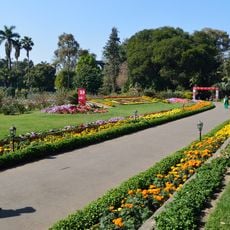
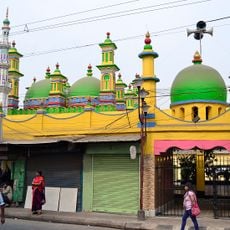
Rabindra Sarobar is an artificial lake of 73 acres in South Kolkata, excavated in the 1920s from marshy land. A white metal suspension bridge with a crisscross truss deck, built in 1926 and renovated in 1962, links the southern shore to an island holding a mosque that predates the lake. Two small square huts, one green and one white with a green roof, stand on a low concrete embankment projecting into the water.
The lake was created by the Calcutta Improvement Trust during the 1920s as Bompas Lake and later renamed after poet Rabindranath Tagore. This 1958 renaming honored his importance to the region's cultural life.
The lake is named after Rabindranath Tagore, and the Japanese Buddhist temple on its southern edge was founded in 1935 by Nichidatsu Fujii of the Nipponzan Myohoji. Monks chant in Japanese to drumbeats at dawn and dusk, and a pillar outside bears a peace message in Japanese beside a pair of komainu lion-dogs. The Durga Exhibition Museum, called Maa Phire Elo, displays award-winning Durga idols replaced after each puja.
The lake is accessible via Rabindra Sarobar metro station or multiple bus routes with sufficient parking available. Wear comfortable shoes if you plan to walk the entire grounds, as the pathways around the lake are quite extensive.
Cannons found during the 1920s excavation lie on the lake's west bank, kept by the Calcutta Improvement Trust for decoration. They are believed to have belonged to Nawab Siraj-ud-daulah, the last independent ruler of Bengal. A mosque on one of the lake islands predates the digging itself, reached by a suspension bridge built in 1926 and renovated in 1962.
The community of curious travelers
AroundUs brings together thousands of curated places, local tips, and hidden gems, enriched daily by 93,119 contributors worldwide.