Lameta Formation, Geological formation in Madhya Pradesh and Gujarat, India.
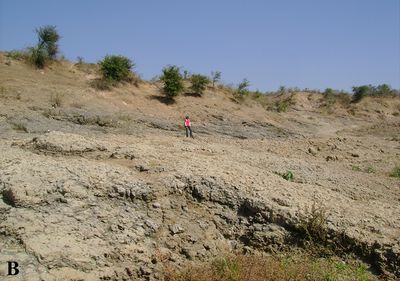
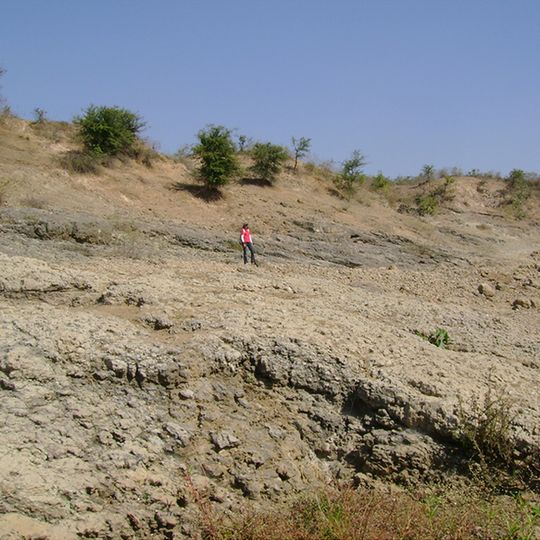
The Lameta Formation, also called the Infratrappean Beds, is a Maastrichtian-age sedimentary formation of alternating clay, siltstone and sandstone laid down in fluvial and lacustrine settings. It lies on the Jabalpur Formation and beneath the Deccan Traps basalt, and appears at the surface only as small isolated outcrops linked to the Satpura Fault.
The first fossils in the Lameta Formation were found between 1917 and 1919. In 1981, G. N. Dwivedi and Dhananjay Mahendrakumar Mohabey of the Geological Survey of India identified the formation after ACC Cement Quarry workers at Rahioli, near Balasinor in Gujarat, handed them limestone structures later recognised as dinosaur eggs.
The formation's name comes from Lameta, the locality where its beds were first mapped. Its dinosaur eggs were identified only after ACC Cement Quarry workers at Rahioli, near Balasinor in Gujarat, handed limestone nodules to geologists G. N. Dwivedi and Dhananjay Mahendrakumar Mohabey of the Geological Survey of India in 1981. The site is now studied for its titanosaur and abelisaur remains.
The formation is exposed only as small, isolated outcrops along the Satpura Fault, so there is no single site to visit. The best-documented locality is the ACC Cement Quarry area at Rahioli, near Balasinor in Gujarat, where the first egg fossils were handed to geologists. Elsewhere the beds lie beneath Deccan Traps basalt or are covered by the Jabalpur Formation.
The formation was first identified in 1981, when geologists G. N. Dwivedi and Dhananjay Mahendrakumar Mohabey of the Geological Survey of India were handed limestone structures by workers of the ACC Cement Quarry at Rahioli, near Balasinor in Gujarat; these were later recognised as dinosaur eggs.
The community of curious travelers
AroundUs brings together thousands of curated places, local tips, and hidden gems, enriched daily by 92,658 contributors worldwide.