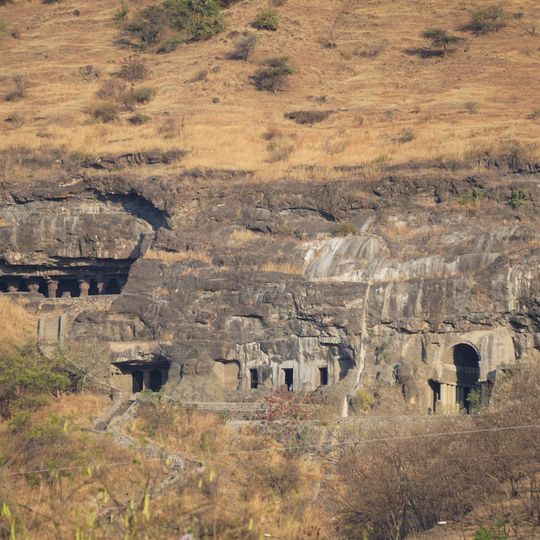
Sambhajinagar Caves, Buddhist caves in Sambhajinagar district, India.
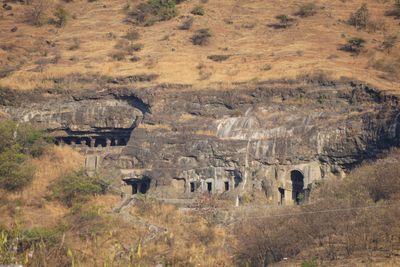
The Sambhajinagar Caves are twelve Buddhist rock-cut shrines in soft basalt, split into a Western Group (Caves I–V), an Eastern Group (Caves VI–IX) and a Northern Cluster of unfinished caves X–XII. The scarp shows a pillared gallery, a rock-cut staircase and plain doorways, with a horseshoe-shaped archway at the far right. Cave III has fretwork, scrolls, couple panels and geometric designs; Cave VII has a veranda and a shrine cell ringed by a circumambulatory passage with monks' cells.
The twelve caves were cut into soft basalt during the 6th and 7th centuries CE. The first reference to them appears in the great chaitya of the Kanheri Caves. They are divided into a Western Group (Caves I–V), an Eastern Group (Caves VI–IX) and a Northern Cluster of unfinished caves (X–XII). Scholars consider Cave III earlier than Cave I and see the site as a link between Ajanta and Ellora.
The walls display carvings that show Buddhist teachings, with cave three holding a large gathering hall and stupa once used for religious ceremonies. These spaces reveal how monks expressed their beliefs through stone carving.
The site sits near main travel routes and welcomes visitors year-round without requiring long journeys to reach. Ask about local guides when you arrive, as they help explain the story of each chamber more clearly.
Cave III is judged older than Cave I, and its fretwork, scrolls, tassel and flower panels and geometric designs are described as the most finished carving at the site. Cave VII repeats the plan of Rameshwar at Ellora (Cave 24): a front veranda, a shrine in the rear wall, a circumambulatory path around it and monks' cells in its walls.
The community of curious travelers
AroundUs brings together thousands of curated places, local tips, and hidden gems, enriched daily by 92,722 contributors worldwide.